

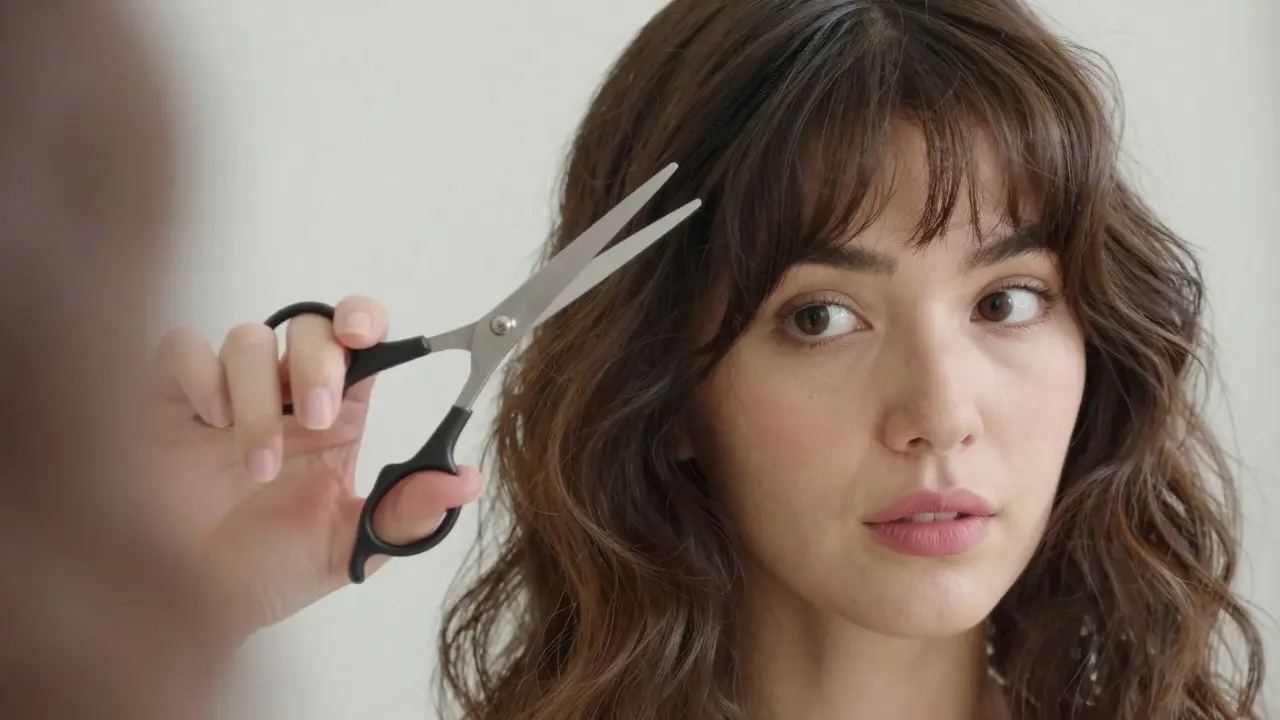
There is nothing quite as terrifying as holding a pair of scissors to your own forehead. You look in the mirror, take a deep breath, and snip. But instead of those soft, face-framing curtain bangs are a versatile hairstyle that parts down the middle and frames the face, blending seamlessly into the rest of the hair. you see a jagged, uneven mess that looks like it was done during an earthquake. If you have wavy hair is hair with a natural S-shaped pattern, typically classified as Type 2A, 2B, or 2C on the Andre Walker scale., the stakes are even higher. Waves shrink when they dry. They curl unpredictably. And if you cut them while they are wet and stretched out, they will bounce up two inches once they air dry.
You do not need to spend $80 at a salon to get this right. In fact, doing it yourself gives you more control over the length and shape. The key is understanding how your specific wave pattern behaves and using the right technique to work with it, not against it. This guide will walk you through exactly how to cut curtain bangs for wavy hair without ruining your day.
Why Wavy Hair Needs a Different Approach
Cutting straight hair is relatively straightforward because the hair falls exactly where you leave it. Wavy hair is dynamic. It has memory. When you pull a section of wavy hair taut to cut it, you are stretching the wave. Once you let go, the wave contracts. This phenomenon is known as "shrinkage." For Type 2A waves, shrinkage might be minimal-perhaps half an inch. For tighter Type 2C waves, it can be several inches.
If you ignore this, your bangs will end up shorter than intended. More importantly, the ends will look blunt and heavy rather than wispy and blended. To avoid this, you must cut your hair in its most natural state or use techniques that account for the spring factor. Most professionals recommend cutting wavy bangs either completely dry or damp but not soaking wet. Dry cutting allows you to see exactly how the wave falls and where the gaps are. Damp cutting is easier for beginners who find dry hair difficult to grip, but you must hold the sections vertically to mimic the fall of gravity.
Gathering Your Tools
Before you make a single cut, ensure you have the right equipment. Using dull kitchen shears will crush the hair shaft, leading to split ends and frizz. You need sharp, professional-grade hair-cutting scissors are specialized stainless steel blades designed specifically for cutting hair, featuring a pivot point and finger rests for precision.. Texturizing shears can be helpful for softening the ends, but they are not strictly necessary if you know how to point cut properly.
- Sharp Hair Scissors: Invest in a good pair. Cheap ones ruin hair.
- Wide-Tooth Comb: Helps detangle without breaking the wave pattern.
- Spray Bottle with Water: For dampening sections if needed.
- Hair Clips: To keep the rest of your hair out of the way.
- Mirror: Ideally, two mirrors so you can see the back and sides simultaneously.
Do not start with freshly washed hair unless you plan to cut it dry after it has fully dried. Freshly washed hair is slippery and hard to control. Day-old hair or hair that has been styled naturally works best because it has some texture and grip.
Sectioning Your Hair Correctly
The foundation of any successful bang cut is proper sectioning. Curtain bangs should blend into the rest of your hair, so you need to isolate the triangle of hair that will become the fringe. Start by parting your hair down the middle from the forehead to the nape of the neck. Then, create a triangular section at the front. The apex of the triangle should be at the crown of your head, and the base should span from ear to ear across the top of your head.
Clip the rest of your hair back securely. Now, focus only on the triangle. Within this triangle, you may want to further divide the hair into three subsections: left, center, and right. This helps maintain symmetry. Some people prefer to cut one side first, then match the other. Others cut the center guide first, then work outward. Both methods work, but cutting the center guide first provides a reference point for length.
Step-by-Step Cutting Technique
Now comes the actual cutting. Remember the golden rule: cut less than you think you need. You can always take more off, but you cannot glue it back on.
- Determine Length: Decide where you want the bangs to fall. For curtain bangs, the shortest point is usually around the cheekbone or just below the eye. The outer edges should gradually lengthen toward the ears. Hold a comb horizontally at your desired length to visualize it.
- Hold Vertically: Take a small subsection of hair from the center. Pull it straight down from the root, keeping tension light. Do not pull it forward or backward; keep it perpendicular to the floor. This mimics how gravity pulls the hair when it is styled.
- Point Cutting: Instead of slicing straight across, turn your scissors vertically and cut into the ends of the hair. This technique, called point cutting, creates a soft, textured edge that blends well with waves. Avoid blunt cuts, which create a harsh line that looks unnatural on wavy hair.
- Check Symmetry: After cutting the center guide, move to the left side. Pull the hair diagonally forward to match the angle of the part. Compare the length to the center guide. It should be slightly longer. Repeat on the right side. Ensure both sides are equal.
- Blend Outward: As you move toward the temples, the hair should get progressively longer. Connect the bangs to the rest of your hair by taking vertical sections and cutting them to match the length of the previous section. This creates a seamless transition.
- Refine Dry: If you cut damp hair, let it dry completely. Once dry, assess the shape. You may notice some pieces sticking out or looking uneven. Use point cutting again to soften any harsh lines. Trim only what is necessary.
Styling and Maintenance
Cutting the bangs is only half the battle. How you style them determines whether they look effortless or messy. For wavy hair, less is more. Heavy products weigh down the waves and cause them to clump together, making the bangs look greasy or stiff.
Start with a lightweight mousse or sea salt spray applied to damp hair. Scrunch the bangs gently to encourage the wave pattern. Avoid brushing them dry, as this causes frizz. Instead, use your fingers to separate and shape them. If you have flyaways, a tiny amount of hair oil or serum smoothed over the surface can tame them without adding weight.
To maintain the shape, trim the bangs every four to six weeks. Wavy hair grows quickly, and the ends can become split or misshapen over time. Regular trims keep the curtain effect fresh and prevent the bangs from growing into the eyes.
| Method | Best For | Risk Level | Precision |
|---|---|---|---|
| Dry Cutting | Experienced users, tight waves (2C) | Low | High |
| Damp Cutting | Beginners, loose waves (2A) | Medium | Medium |
| Blunt Cutting | Straight hair only | High for waves | Low for waves |
Common Mistakes to Avoid
Even with the best intentions, mistakes happen. One common error is cutting the bangs too short in the center. Because curtain bangs part in the middle, the center piece needs enough length to sweep away from the face. If it is too short, it will stick straight up or fall directly into your eyes.
Another mistake is ignoring the direction of the wave. Wavy hair often has a natural growth pattern that pushes hair to one side. If you cut against this pattern, the bangs will fight you every morning. Always observe how your hair naturally falls before cutting. Work with the grain, not against it.
Finally, do not skip the blending step. Curtain bangs should not look like a distinct block of hair attached to the rest of your head. They must fade gradually into the layers. If the transition is abrupt, the style will look dated and chunky.
Should I cut my bangs wet or dry?
For wavy hair, dry cutting is generally recommended because it allows you to see the true length and behavior of the waves. However, if you are a beginner, damp cutting is acceptable as long as you hold the hair vertically and account for shrinkage by leaving extra length.
How much should I trim each time?
Trim only a quarter to half an inch at a time. It is easy to cut too much, especially with wavy hair that shrinks. You can always go back and cut more, but you cannot add hair back.
Can I use regular scissors?
While possible, regular scissors are not ideal. They are not designed for hair and can cause split ends. Professional hair-cutting scissors provide a cleaner cut and last longer. If you must use regular scissors, ensure they are extremely sharp.
How do I fix uneven bangs?
If one side is shorter, do not immediately cut the longer side to match. Instead, try styling the shorter side to see if it balances out. If it still looks uneven, carefully point cut the longer side to reduce the difference. Small adjustments are better than large cuts.
Do curtain bangs work on thick wavy hair?
Yes, but you may need to thin out the bulk. Thick wavy hair can look heavy and bulky if not textured properly. Use point cutting aggressively to remove weight and allow the waves to flow freely. Consider asking a stylist to thin the ends if you are unsure.


Robert Barakat
July 21, 2026 AT 17:00The act of cutting one's own hair is a profound meditation on control and surrender. We stand before the mirror, armed with steel, attempting to impose order upon the chaotic entropy of our own biology. It is a futile yet necessary struggle against the natural state of disorder.
Michael Richards
July 22, 2026 AT 21:50You are all idiots for thinking you can do this yourself. The article says use sharp scissors but most of you are using kitchen shears from Walmart. Just go to a salon and pay the $80 because your hair will look like trash otherwise. Stop wasting time reading tutorials that don't account for human error.
Laura Davis
July 23, 2026 AT 11:14Okay, first off, stop being so negative! This guide is actually super helpful if you just follow the steps. I tried it last week and while it wasn't perfect, it was way better than my previous disaster. You really need to listen to the part about shrinkage though. If you have wavy hair, trust me, dry cutting is the only way. Don't let anyone tell you otherwise!
Lisa Nally
July 23, 2026 AT 21:03Actually, the terminology used here is slightly misleading. When we discuss 'shrinkage' in Type 2C hair, we are referring to the contraction of the hydrogen bonds within the cortex upon drying. Most amateurs fail to understand that point cutting isn't just aesthetic; it reduces the bulk density at the terminal ends, allowing for better wave propagation. Also, using texturizing shears incorrectly can cause excessive frizz due to cuticle damage. Be precise or don't bother.
Edward Gilbreath
July 24, 2026 AT 09:37salons want your money they dont care about your hair. big beauty industry lies. i cut mine with steak knives once worked fine. just dont tell them.
kimberly de Bruin
July 26, 2026 AT 05:18the mirror reflects not just our face but our inner chaos. to cut is to change. to change is to risk. perhaps the bangs are merely a metaphor for the fleeting nature of youth itself.
Edward Nigma
July 27, 2026 AT 09:05Everyone says dry cutting is best but that’s totally wrong. Wet cutting gives you more tension and control over the sectioning. Dry hair slips around everywhere making it impossible to get straight lines. You’re all following bad advice from influencers who don’t know anatomy. Wet is superior for precision.
Francis Laquerre
July 28, 2026 AT 01:21In many cultures across Asia and Europe, the concept of self-grooming varies wildly. In Japan, for instance, the precision required for a bob is considered an art form passed down through generations. Here, we often rush the process. It is tragic how we view hair as disposable rather than a canvas of personal expression. One must approach the scissors with the reverence of a calligrapher approaching ink.
michael rome
July 29, 2026 AT 07:34It is imperative that one considers the structural integrity of the hair shaft before initiating any truncation procedure. Many individuals neglect the fundamental aspect of hydration which leads to brittleness. Furthermore, the psychological impact of a failed haircut cannot be overstated. One should proceed with caution and perhaps consult a professional if uncertainty persists regarding the optimal length.
Andrea Alonzo
July 29, 2026 AT 19:58I think it is really important to remember that everyone's hair is different, and what works for one person might not work for another, so please be kind to yourselves when you try this new technique because mistakes are just part of the learning process and they help us grow into better versions of ourselves who understand our unique textures and patterns more deeply over time.
Saranya M.L.
July 29, 2026 AT 21:24Westerners always complicate simple things. In India, we manage thick, humid-resistant hair without such elaborate tools. The key is understanding the wave pattern locally. Your 'shrinkage' is just poor product choice. Use natural oils instead of these chemical-laden mousses. The jargon here is unnecessary fluff designed to sell you expensive scissors. Simple techniques work best if you respect the hair's natural structure.
om gman
July 30, 2026 AT 18:59oh wow another tutorial. i bet none of you actually read past the title. you people are so boring with your step by step guides. life is messy why does hair have to be neat? just chop it off and deal with the consequences like adults.