

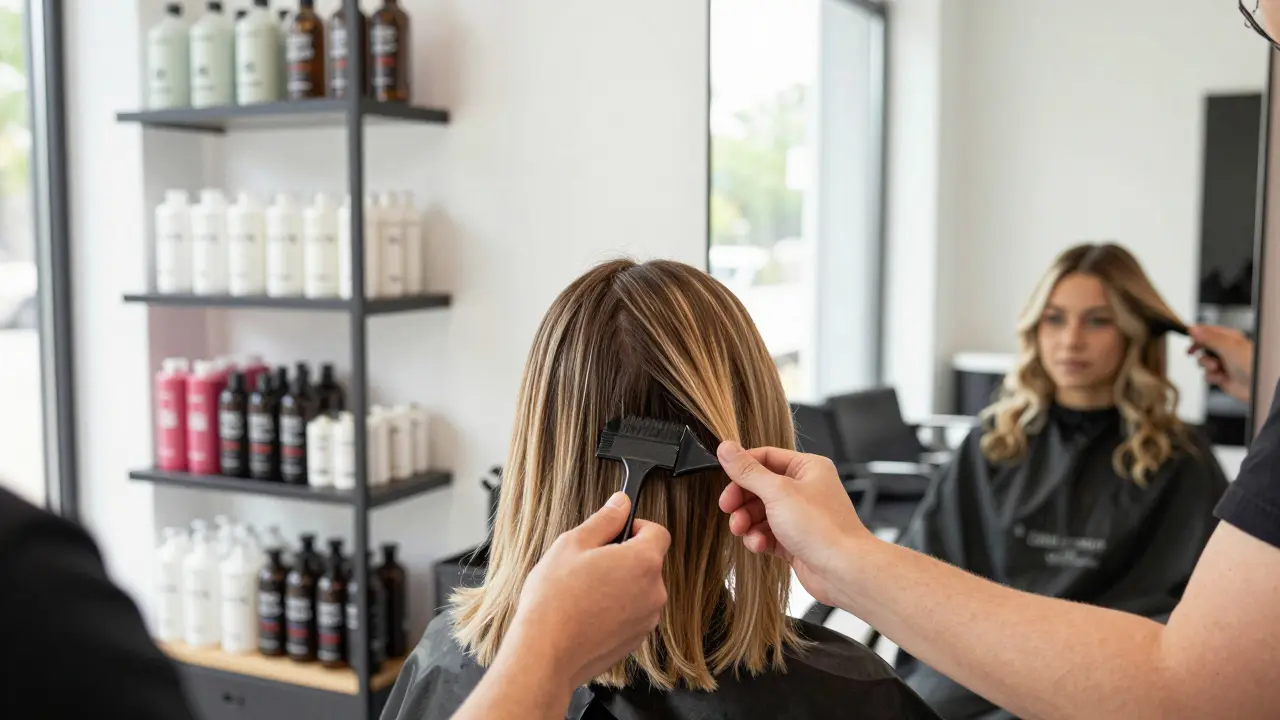
Ever walked into a salon, sat down, and then froze when the stylist said, "So, what color are you thinking?" - only to realize you have no idea how much it’ll cost? You’re not alone. Hair dye isn’t just about picking a shade. It’s about understanding what you’re really paying for: time, skill, product quality, and how much your hair has been through.
In 2026, salon hair dye prices in the U.S. range from $45 to over $450. That’s a huge gap. But it’s not random. The difference comes down to five things: the type of color, the salon’s level, your hair’s condition, your location, and who’s doing the work. Let’s break it all down - no fluff, just real numbers from real salons.
Single-Process Color: The Basic Change
This is the simplest service: one color applied all over. Think going from dark brown to medium brown, covering grays, or adding a subtle shine. It’s what most people start with.
At budget chain salons like Supercuts, you can get single-process color for as low as $45. Mid-range salons - the kind you find in strip malls or local neighborhoods - usually charge between $50 and $70. But if you’re in a city like Asheville, San Francisco, or New York, even basic color can hit $85-$100. Why? Because rent, wages, and product costs are higher.
Here’s the catch: if your hair is already colored, damaged, or has been bleached before, the price goes up. Why? Because the stylist has to work around past damage. They might need extra toner, a pre-treatment, or even two sessions to get the color right. That’s not always obvious until you’re in the chair.
Double-Process Color: Lighten + Color
Going from dark to light? That’s double-process. You need bleach first, then color. It’s two steps. Two sets of chemicals. Two rounds of processing time. And it’s where most people get surprised by the bill.
Double-process services typically cost $100-$200. If you’re going from black hair to platinum blonde? You’re looking at $180-$350. Why? Because it’s not one appointment. Most salons split this into two visits - one to lift, another to tone. Rushing it breaks hair. And no good stylist will risk that.
At-home kits for double-process cost $20-$70. But here’s the truth: 7 out of 10 people who try it at home end up with orange, brassy, or patchy results. And fixing that? That’s color correction - which costs more than the original job.
Highlights: Foil, Balayage, Babylights
Highlights aren’t one thing. They’re a family of techniques - and each has its own price tag.
- Full foil highlights: $75-$115 at mid-range salons. At luxury spots, $200-$350. This means every strand is wrapped in foil. Time-consuming. Precision work.
- Partial foil: $95-$130. Usually just around the face or top layers. Great for subtle lift.
- Face-framing highlights: $40-$75. Just the pieces around your face. A quick, affordable way to brighten your look.
- Balayage: $100-$150 on average. This is hand-painted, no foils. It mimics sun-kissed hair. In Asheville or Austin, expect $120-$180. In Chicago or Miami? $180-$300.
- Babylights: $120-$200. Super fine, delicate highlights. Like real baby hairs. Takes hours. Worth it if you want a natural, multidimensional look.
StyleSeat’s 2026 data shows balayage prices can swing from $75 to $450. Why? Because one stylist’s "balayage" might be two sections. Another’s might be 150 individual hand-painted strands. You’re paying for detail.

Ombre and Color Correction: When Things Get Complicated
Ombre is a gradient - dark at the roots, light at the ends. It’s not just a color. It’s a design. Prices range from $130 to $200. If your hair was previously dyed dark and you want to go ombre? That’s two services: removal + new color. That’s $250+.
Color correction? That’s the $100/hour zone. If you tried a box dye and turned your hair neon green? Or if your last salon left you with orange roots? That’s correction. It’s not a service. It’s surgery.
Salons charge hourly here because every head is different. One client might need 90 minutes. Another might need 3 hours. The stylist has to assess damage, neutralize tones, rebuild pigment - and sometimes it takes two visits. A good correction isn’t just about color. It’s about saving your hair.
Extra Services: Toner, Gloss, Tip Color
Most people don’t realize color isn’t done when the dye rinses out. There are add-ons - and they add up.
- Toner: $25-$90. Used after bleach to remove brassiness. A basic toner might be $25. A full toning service with conditioning? $70-$90.
- Color gloss: $30-$95. A semi-permanent shine coat. Great for refreshing color between visits. Not a full dye job.
- Tip color: $25-$40. Just the ends. A fun, low-commitment change. Popular with teens and people who don’t want to commit to full color.
- Free-hand painting: $115-$450. Artistic, custom color. Think rainbow streaks, pastel gradients, or fantasy colors. This is for people who want to stand out.
Some salons now add a $1 “environmental stewardship fee” for sustainable products. It’s not a scam - it’s transparency. You’re paying for cleaner formulas.
What Makes the Price Jump?
Not all salons are equal. Here’s what really affects cost:
- Stylist experience: A junior stylist might charge $60 for color. A master colorist with 10+ years? $150-$250. You’re paying for their eye, their technique, their ability to predict how color will behave.
- Hair length and thickness: Shoulder-length hair? Standard price. Waist-length? Add 25-50%. Thick, curly hair? More product. More time. More cost.
- Hair history: Virgin hair (never colored) is easiest. Hair that’s been bleached twice? That’s a challenge. It needs extra care - and extra product.
- Location: A salon in downtown Asheville might charge $100 for balayage. One in rural North Carolina? $75. Big cities = higher overhead = higher prices.
- Product quality: High-end salons use Olaplex, Redken, or Wella. Budget places use drugstore brands. The difference shows in shine, longevity, and hair health.
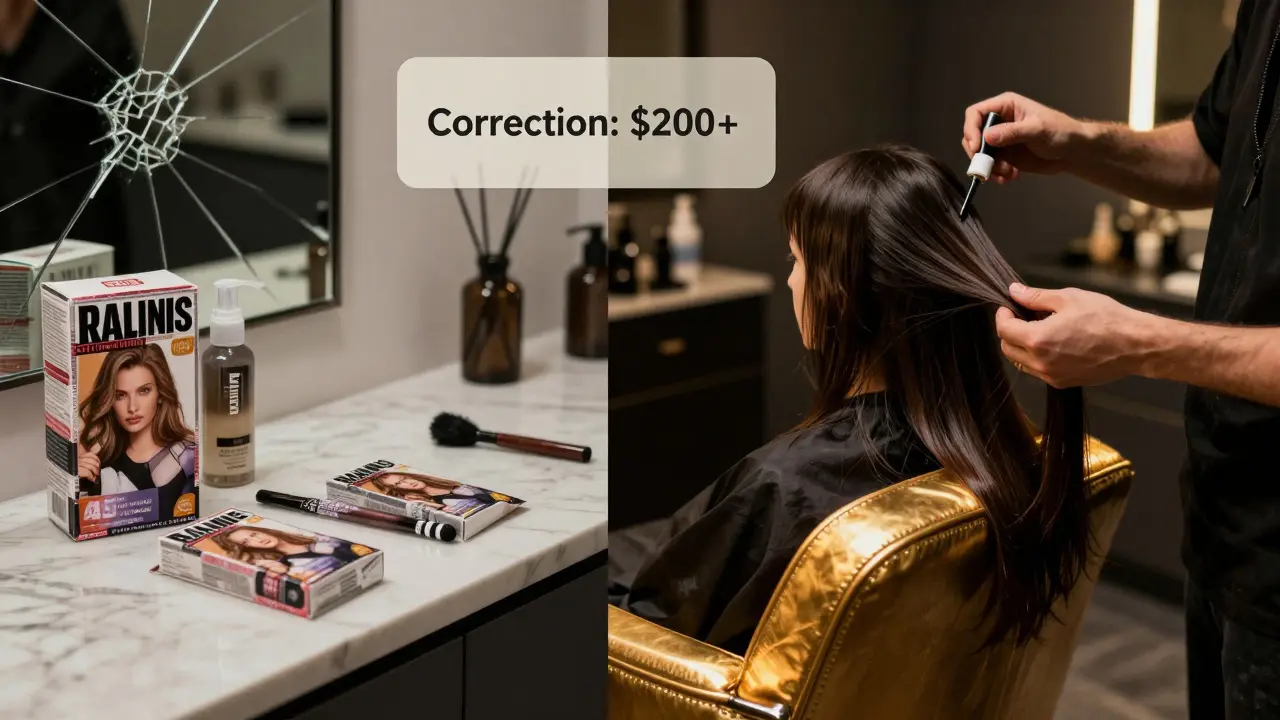
At-Home vs. Salon: Is It Worth It?
Box dye kits cost $7-$40. Bleach kits? $10-$30. Toner? $5-$15. That’s a steal compared to salon prices.
But here’s the reality: 68% of people who dye at home say they regret it. Why? Because they didn’t account for:
- How much their hair has changed since the last color
- How long the color takes to process
- How to avoid patchiness on thick or curly hair
- How to tone out brassiness
At-home color works best if you’re going 2-3 shades darker. Going lighter? You need bleach. And bleach is risky without training. One mistake, and you’re looking at a $200 correction.
Think of it like DIY plumbing. You can fix a leak. But if you break the pipe? You’re calling a pro - and paying double.
How to Save Money Without Sacrificing Quality
You don’t have to pay $300 for balayage. Here’s how to get smart:
- Start with partial highlights. Face-framing or a few foils around the crown. Less cost. Big impact.
- Ask for a consultation first. Good salons offer free color assessments. They’ll tell you if your hair can handle it - and how many sessions it’ll take.
- Book with a junior stylist. They’re cheaper. And if they’re trained by a master, they’re still great.
- Use a loyalty card. Many salons offer discounts after 3 visits.
- Book during off-hours. Mid-week afternoons often have lower rates.
- Ask for a gloss instead of full color. It refreshes tone without lifting pigment.
And if you’re unsure? Go for a toner or gloss first. It’s cheaper. Safer. And you can always go darker later.
Final Takeaway: You Get What You Pay For
Hair color isn’t a commodity. It’s a skill. A science. A custom art form.
That $45 color at Supercuts? It’ll fade in 3 weeks. That $150 balayage at a boutique salon? It’ll last 6-8 weeks, look natural, and leave your hair healthier than when you walked in.
Don’t just shop for price. Shop for results. Ask to see the stylist’s portfolio. Ask what products they use. Ask how they’ll protect your hair.
Because your hair isn’t just color. It’s your statement. And it deserves more than a box.
How much does it cost to dye hair at a salon in 2026?
Salon hair dye costs vary widely. Single-process color starts at $45 at budget salons and averages $50-$100. Double-process (lighten + color) ranges from $100-$200. Highlights cost $75-$350 depending on technique. Balayage runs $100-$450. Color correction is typically $100 per hour.
Is it cheaper to dye hair at home?
Yes, at-home kits cost $7-$40, but they only work well if you’re going darker by 2-3 shades. Lightening, correcting mistakes, or achieving salon-quality highlights usually ends up costing more in the long run because of damage and the need for professional fixes.
Why is balayage more expensive than regular highlights?
Balayage is hand-painted, not foiled, which takes more time and skill. It’s designed to look natural, like sun-kissed hair, requiring precision placement. A full balayage can take 2-3 hours, while foil highlights take 1-1.5 hours. The technique and artistry justify the higher price.
What’s the difference between toner and gloss?
Toner is used after bleaching to neutralize unwanted tones like yellow or orange. It’s a corrective step. Gloss is a semi-permanent color treatment that adds shine and refreshes faded color. Toner is more technical; gloss is more about maintenance and shine.
Can I save money by booking a junior stylist?
Yes. Junior stylists often charge 20-40% less than masters. If they’re trained by a senior colorist and have good reviews, they can deliver excellent results - especially for basic color or gloss services. Avoid them for complex corrections or lightening jobs.
Does hair length affect the price?
Absolutely. Longer hair needs more product and more time. A full color on shoulder-length hair might cost $70. On waist-length hair, it could be $120-$150. Thick or curly hair also increases cost because it absorbs more color and takes longer to process evenly.

Tina van Schelt
February 12, 2026 AT 08:22Okay but have y’all noticed how salons now charge extra for ‘sustainable products’? Like, I get it - I want clean formulas too. But when I paid $180 for balayage and got slapped with a $15 ‘eco fee,’ I felt like I was tipping the shampoo bottle. Meanwhile, my hair looked like a sunset that got into a fight with a rainbow. Worth it? Maybe. Fair? Debatable.
Mike Zhong
February 13, 2026 AT 20:33You people treat hair like it’s a sacred temple and stylists like priests. Newsflash: it’s dye. It grows out. It fades. You’re paying for someone’s ego wrapped in a $200 bottle of Olaplex. I’ve had my hair dyed by a 22-year-old in a basement who used drugstore dye - lasted six months, looked better than my last salon job. Stop romanticizing the process. It’s chemistry. Not art.
Jamie Roman
February 13, 2026 AT 21:21I really appreciate how detailed this breakdown is - it’s rare to see someone lay out the real variables behind pricing. I used to think balayage was just ‘fancy highlights,’ but now I get it: it’s not just technique, it’s intention. One stylist might do 12 sections; another might do 180. The time difference is insane. I went from full foil to face-framing after my last disaster - saved $120 and still looked like I’d just come back from vacation. Also, toner is not optional. If you skip it, you look like a burnt toast sandwich.
And yes, junior stylists are underrated. My last one was trained by a master who left the salon - she’s cheaper, but her color math is flawless. Just ask to see their portfolio. Don’t assume price = skill.
Salomi Cummingham
February 14, 2026 AT 23:57OH MY GOD, I JUST REALIZED I’VE BEEN PAYING $300 FOR BALAYAGE IN LONDON AND MY FRIEND IN BATH GETS THE SAME THING FOR $110. I’M NOT EVEN JOKING. I WENT TO A ‘LUXURY’ SALON BECAUSE THE WALLS WERE PAINTED MOSS GREEN AND THEY HAD A CANDLE ON THE SINK. I WASN’T GETTING HAIR. I WAS GETTING A VIBES EXPERIENCE. I’M SO SORRY, I’M SO SORRY, I’M SO SORRY. I’M CRYING. I NEED A REFUND. I NEED A THERAPIST. I NEED TO GO BACK TO BATH.
Also - gloss? YES. I do it every 6 weeks. It’s like a facial for your hair. I’ve never had a bad gloss. Ever. My hair feels like silk. My cat licks it. He knows.
Johnathan Rhyne
February 15, 2026 AT 16:41Correction: ‘7 out of 10 people who try it at home end up with orange, brassy, or patchy results.’ That’s not a statistic. That’s a made-up number. Where’s your source? I’m not saying it’s wrong - I’m saying you’re being lazy. And you say ‘Olaplex, Redken, Wella’ like they’re holy trinities. Newsflash: some salons use those brands to justify $400 jobs while charging $40 for the same service down the street. Brand =/= quality. Also - ‘environmental stewardship fee’? That’s a fancy way of saying ‘we’re adding a tip.’
Jawaharlal Thota
February 17, 2026 AT 10:06As someone from India who moved to the US for work, I’ve learned that hair color here is not just a service - it’s a cultural ritual. Back home, we dye hair for weddings or festivals, and it’s usually done by family or local barbers for under $10. But here? You’re paying for the entire experience - the chair, the music, the consultation, the ‘I see your potential’ energy. It’s expensive, yes. But if you want hair that lasts and doesn’t turn into a science experiment, you pay. I’ve done both - salon and home. The salon version didn’t fade in 3 weeks. It lasted. And I didn’t cry in the shower. Worth every penny.
Also - never try balayage at home. I did. My hair looked like a tiger that got into a paint factory. I had to get it corrected. Cost me $220. Lesson learned.
Lauren Saunders
February 18, 2026 AT 11:18How quaint. You all think this is about hair. It’s not. It’s about class. The $45 Supercuts job? That’s for people who don’t value themselves. The $450 balayage? That’s for people who understand that aesthetics are currency. If you can’t afford to invest in your appearance, you’re not investing in your brand. And let’s be honest - if you’re still using ‘vocabulary: colorful’ as a trait, you’re probably still wearing fast fashion. Just saying.
sonny dirgantara
February 19, 2026 AT 03:12Andrew Nashaat
February 20, 2026 AT 03:33Correction: You say ‘68% of people who dye at home regret it.’ Where’s your citation? You didn’t cite a single source. That’s not data - that’s opinion masquerading as fact. Also - ‘hair that’s been bleached twice’? That’s not a technical term. You mean ‘pre-lightened hair with compromised cuticle integrity.’ And you say ‘color correction is surgery’ - but you don’t mention that most salons don’t have licensed trichologists on staff. So who’s doing the ‘surgery’? A guy who did a YouTube course? Also - ‘environmental stewardship fee’? That’s not transparency - that’s greenwashing. You’re selling guilt. And you call that ethics?
Gina Grub
February 22, 2026 AT 00:44Nathan Jimerson
February 23, 2026 AT 10:41I’ve been doing my own hair for years - and I’ll never go back to a salon. I made mistakes. I burned my scalp once. But I learned. I read. I watched videos. I bought good tools. Now my hair looks better than it ever did at a salon - and I saved over $2,000 in two years. Yes, it takes time. Yes, it’s messy. But you don’t need a $300 stylist to look good. You need patience and curiosity. And maybe a good pair of gloves.
Also - if you’re scared of doing it yourself, start with a gloss. It’s safe. It’s fun. And it’s a great way to learn how your hair reacts to color. You’ve got this.