

You’ve seen them on the subway, at concerts, or scrolling through your feed: people with electric blue, neon green, or violet hair. It looks stunning, but have you ever wondered why you don’t see babies born with that same vibrant hue? If you dig into biology textbooks, you’ll find that human hair comes in a limited palette-black, brown, blond, red, and gray. But blue? That’s missing from nature’s menu.
It’s not just an aesthetic choice; it’s a biochemical constraint. Humans simply don’t have the genetic machinery to produce a blue pigment in our hair follicles. To understand why, we need to look under the microscope of your own scalp. Your hair color isn’t painted on; it’s built from two specific types of melanin biological pigments produced by cells called melanocytes within the hair follicle. These are eumelanin (which creates black and brown shades) and pheomelanin (which creates yellow and red shades). There is no third "blue-melanin" gene waiting to be activated.
The Two-Pigment System: Why Our Palette Is Limited
Think of your hair color as a mixing board with only two sliders: one for darkness (eumelanin) and one for warmth (pheomelanin). When you have high levels of eumelanin, your hair is dark brown or black. If you have low eumelanin but high pheomelanin, you get red or strawberry-blond hair. Low levels of both result in blond hair. If melanin production stops entirely, the hair grows out white or gray.
This system works well for camouflage and UV protection in our evolutionary history, but it doesn’t offer a route to blue. According to data from MedlinePlus Genetics, hair color depends almost entirely on the ratio and concentration of these two pigments. Unlike birds or butterflies, which can manipulate light to create blues without blue pigment, humans rely on chemical absorption. We absorb certain wavelengths of light and reflect others. Eumelanin absorbs most visible light, making hair appear dark. Pheomelanin reflects longer wavelengths like red and yellow. Neither pigment naturally reflects the short blue wavelengths required to make hair look blue.
Structural Color vs. Pigment Color: How Birds Pull Off Blue
If humans can’t make blue pigment, how do animals like blue jays, peacocks, and morpho butterflies achieve those iridescent blues? They use a trick called structural coloration. This isn’t about dye; it’s about physics.
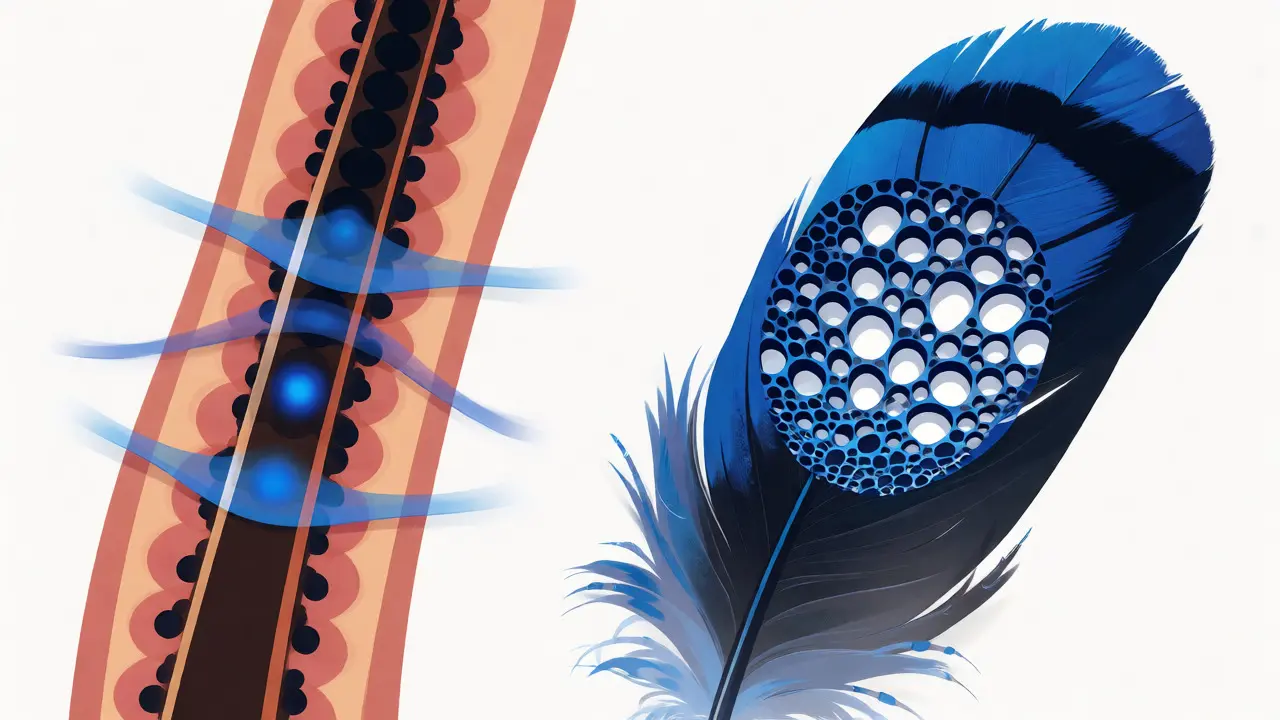
In bird feathers, microscopic structures made of keratin and air pockets scatter light. These nanostructures are spaced perfectly to reflect blue light while absorbing other colors. A layer of melanin at the base prevents the feather from looking white or washed out. Human hair shafts, however, lack this specialized architecture. While human hair has layers-the cuticle, cortex, and sometimes medulla-it doesn’t have the spongy, air-filled nanostructure needed to bounce back blue light efficiently.
| Feature | Human Hair | Blue Bird Feathers |
|---|---|---|
| Color Source | Pigment absorption (Eumelanin/Pheomelanin) | Structural scattering + Pigment background |
| Mechanism | Chemical bonds absorb specific light wavelengths | Nanostructures physically reflect blue light |
| Stability | Changes with age (graying), sun exposure fades pigment | Structure-dependent; damage ruins color |
| Blue Capability | None naturally | Vibrant, metallic, or matte blues |
This distinction is crucial. When you see a dog described as having a "blue" coat, like a Blue Heeler, it’s usually a visual illusion created by a mix of black and white hairs, or a dilution of black pigment, not true blue structural color. In mammals, blue skin (like in mandrills) can occur due to collagen scattering, but this optical phenomenon hasn’t evolved in human hair fibers.
What About "Blue-Black" Hair?
You might argue, "But I know someone with blue-black hair!" You’re right, but that’s an optical effect, not a new pigment. Extremely dark hair contains such dense concentrations of eumelanin that it absorbs almost all light. Under certain lighting conditions-especially cool, blue-toned daylight-the slight reflection off the smooth surface of the hair shaft can pick up blue hues from the environment. This is similar to how a black car can look blueish under streetlights.
This sheen is caused by the Tyndall effect or simple specular reflection, where the angle of light and the smoothness of the cuticle play a role. It’s temporary and dependent on lighting. If you take that same person indoors under warm yellow lights, their hair will likely look pure black or brown again. True natural blue hair would maintain its hue regardless of lighting conditions because the pigment itself would be blue.
Could Evolution Ever Give Us Blue Hair?
Hair color is polygenic, meaning many genes influence the outcome. Scientists have identified over 11 genes involved in hair pigmentation, including MC1R, which controls the switch between eumelanin and pheomelanin. Mutations in MC1R cause red hair. Other genes like OCA2 and HERC2 affect eye and hair color intensity.
For humans to evolve natural blue hair, we wouldn’t just need a mutation in one gene. We’d likely need a complex, coordinated change in multiple genes to either create a new blue-absorbing polymer or restructure the hair shaft’s internal geometry to support structural color. Given that our current two-pigment system has served us well for hundreds of thousands of years, there’s been no strong evolutionary pressure to develop blue hair. Camouflage in ancestral environments favored browns, blacks, and tans, not bright blues.
How People Get Blue Hair Today
Since nature didn’t give us blue hair, humans invented ways to fake it. Modern hair dyes work by bypassing the biological limitations:
- Bleaching: Most blue dyes require bleaching first. This removes the natural eumelanin and pheomelanin, creating a blank canvas. Without removing the underlying yellow or orange tones, blue dye mixes with them to create green or muddy results.
- Direct Dyes: Semi-permanent blue dyes sit on top of the hair cuticle or penetrate slightly into the cortex. They don’t change the DNA or melanin production; they just add external color.
- Oxidative Dyes: Permanent dyes use chemicals like ammonia and hydrogen peroxide to open the cuticle and deposit artificial pigments deep inside the hair fiber.
So, when you see vivid blue hair, you’re looking at chemistry applied externally, not biology expressed internally. It’s a testament to human ingenuity, not a glimpse of a hidden genetic trait.
Is it possible for a baby to be born with blue hair?
No, babies are not born with natural blue hair. Newborns often have fine, unpigmented or lightly pigmented hair that may appear blond, white, or gray. As they grow, melanocyte activity increases, typically resulting in darker shades like brown or black. Any blue appearance in infancy is usually due to lighting reflections or mixed pigmentation, not a blue pigment.
Why does my black hair look blue in sunlight?
This is an optical illusion known as structural reflection. Very dark hair has a smooth surface that reflects ambient light. In direct sunlight, especially if the sky is blue, the hair shaft reflects some of that blue light. Additionally, very high concentrations of eumelanin can sometimes create a subtle blue-violet sheen due to the way light scatters off the dense pigment particles, but the pigment itself remains black-brown.
Can genetics mutate to create blue hair?
Theoretically, yes, but it’s highly unlikely in the near future. It would require significant mutations affecting both pigment synthesis pathways and possibly hair shaft structure. Currently, known genetic variations only alter the ratio of eumelanin to pheomelanin or reduce pigment production, leading to red, blond, or gray hair, not new colors like blue or green.
Are there any animals with natural blue hair?
True blue fur is extremely rare in mammals. Some animals, like the Colobus monkey or certain dogs, have "blue" coats, but this is usually a dilution of black pigment or a mix of black and white hairs creating a gray-blue appearance. Most true blues in the animal kingdom, like birds and fish, rely on structural coloration rather than blue pigment.
Does gray hair turn blue before turning white?
No. Gray hair occurs when melanocytes stop producing melanin. The hair becomes transparent or white. It may appear yellowish due to environmental staining or product buildup, but it does not pass through a blue phase. If you see blue tints in gray hair, it’s likely from purple shampoos used to neutralize yellow tones or external dye residue.

Mithilesh Singh
October 23, 2026 AT 20:57Finally, someone explains this properly!!!. People are so stupid these days, they think everything is natural just because it looks pretty on Instagram.. It is disgusting how society has lost its way.. We need to stick to what God made us with.. Black, brown, red.. that is enough!! No one needs blue hair to be special.. This article is correct and everyone should read it carefully.. Do not let the woke mob tell you otherwise!!!.
SHANNON GRUBER
October 24, 2026 AT 00:48Yeah okay. The structural coloration part is barely scratching the surface. You're missing the whole point about photonic crystals in keratin matrices. But whatever, it's a blog post, not a peer-reviewed journal. I've seen better summaries in high school textbooks. Honestly, the distinction between pigment and structure is obvious if you actually studied biology instead of just reading headlines. Lazy writing.
Prayagraj Medicose
October 24, 2026 AT 07:13Dude seriously?? You guys are all missing the real story here. They don't want us to have blue hair because blue is the color of truth and they want to keep us in the dark! If we had blue hair, we'd see the frequencies differently and realize the government is hiding something big in our DNA. Why do you think they suppress this info? It's all connected to the water fluoridation too. Wake up people, stop believing the mainstream narrative about melanin!
Manoj Kumar
October 24, 2026 AT 14:21I must respectfully disagree with the superficial analysis presented herein. The reduction of human pigmentation to merely two melanin types ignores the complex interplay of genetic epigenetics which remains largely unexplored by the layperson. Furthermore, the comparison to avian structural coloration is flawed as mammalian follicular architecture operates under entirely different thermodynamic principles. One must consider the socio-economic implications of dye industries profiting from this biological limitation. It is suspicious that such simple science is marketed as profound revelation. The author fails to acknowledge the potential for synthetic biology interventions already underway in private laboratories. This article serves more as entertainment than education.
Brad Walker
October 26, 2026 AT 07:41But wait... if nature didn't make blue, why does the sky feel like it's watching us? Is blue hair a rebellion against the cosmos? We are trapped in a cage of brown and black, screaming into the void of genetics. Maybe we aren't meant to be blue. Maybe blue is the color of pain. Or maybe it's just chemistry. But isn't all life just chemistry pretending to be soul? I'm crying over my own hair right now. It's tragic really. The universe denies us the azure. We bleed red, but we dream blue. And we fail. Always we fail.
Hemali Jaiswal
October 26, 2026 AT 09:18This is such a beautifully articulated breakdown of a fascinating topic! 🌈 It’s wonderful to see science explained with such clarity and respect for the reader’s curiosity. I love how you highlighted the difference between pigment-based color and structural color-it really helps demystify why birds can achieve those iridescent effects while we cannot naturally. For anyone feeling discouraged about their natural hair shade, remember that our diversity is a testament to evolutionary history, not a limitation! Embrace your unique palette, whether it’s deep ebony, warm copper, or sun-kissed gold. Nature’s artistry is vast and varied, and every shade tells a story of survival and adaptation. Keep learning and celebrating the wonders of biology! ✨
Howard Hurd
October 27, 2026 AT 10:49Look, I know a lot about this stuff, trust me. In America, we invented the best dyes. Period. 💅🇺🇸 You think other countries can match our chemical engineering? Nah. We solved the blue problem before Europe even figured out shampoo. It’s basic American ingenuity. Don’t believe the hype about 'natural' being better. Natural means boring. We choose freedom. Freedom to look like a Smurf if we want. That’s liberty. 👊🏼🦅
Sean Eagen
October 28, 2026 AT 05:39Blue hair is unnatural. End of story.