

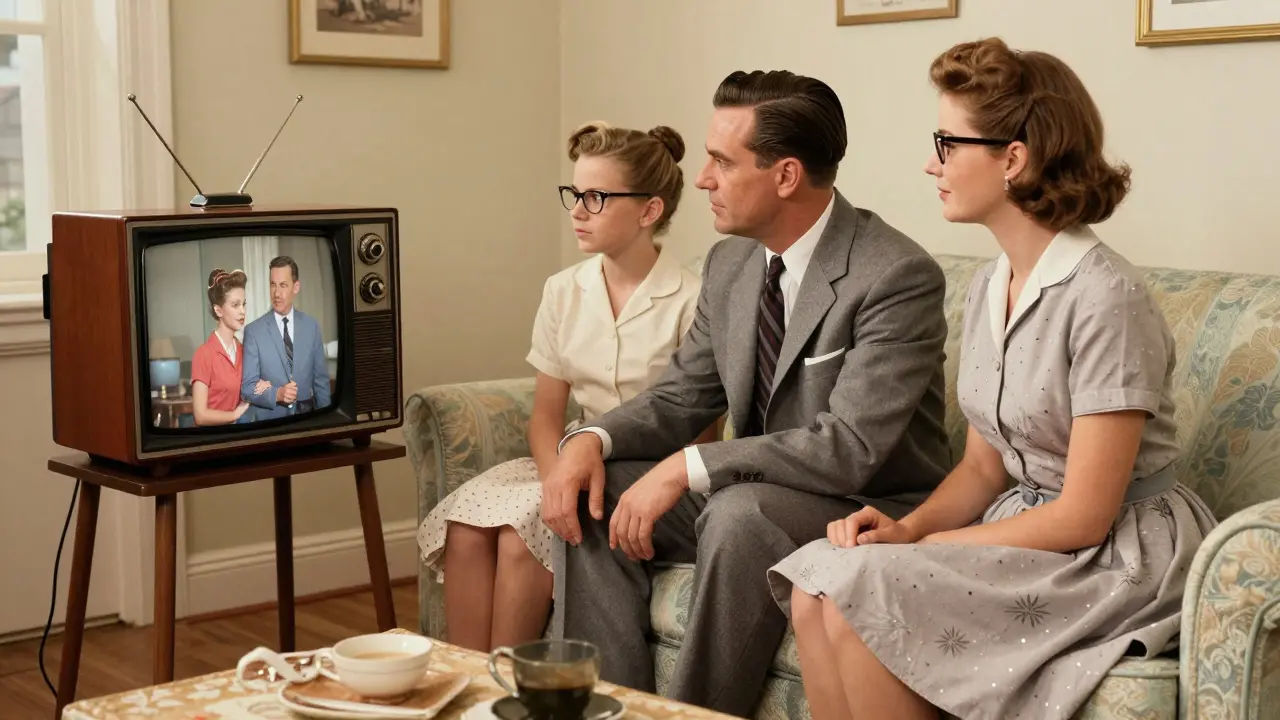
Look at any family photo album from the mid-20th century, and you might notice something strange. It’s not just that people wore suits or dresses; it’s that they seemed to wear the *exact same* ones. Men had identical pompadours and narrow ties. Women sported matching bouffant hairdos and cat-eye glasses. If you closed your eyes and imagined a "typical" person from 1955, you could probably draw them without looking at a reference. But why did everyone in the 1950s and 60s look so remarkably similar? Was it a lack of creativity, or was there a powerful force shaping how millions of people presented themselves to the world?
The answer isn’t that people lacked individuality. In fact, the desire to stand out has always been human nature. Instead, this visual uniformity was the result of a perfect storm: limited media channels, rigid social norms, industrial manufacturing constraints, and a collective psychological need for stability after global conflict. Understanding this era helps us see how much our current diverse landscape is actually a recent phenomenon.
The Monoculture of Mass Media
To understand why styles converged, you have to look at where people got their information. Today, you scroll through TikTok, Instagram, and YouTube, seeing thousands of different aesthetics simultaneously. In the 1950s and early 1960s, the average American household had access to only three major television networks: NBC, CBS, and ABC. Radio was popular, but it didn't show you what to wear. Print magazines like Vogue, LIFE, and Esquire were expensive and often reached only urban or affluent audiences.
This meant that when a trend started-say, the poodle skirt or the fedora-it spread slowly and uniformly across the country. There was no algorithmic fragmentation. Everyone watched I Love Lucy on the same night. They saw the same commercials. They read the same advice columns. This created a "monoculture," a term coined by sociologist George Ritzer, where a single set of cultural products dominates the entire society. When everyone consumes the same media, they inevitably adopt the same style cues.
| Feature | 1950s-60s Era | Modern Era (2020s) |
|---|---|---|
| TV Channels | 3 Major Networks | Hundreds (Cable + Streaming) |
| Fashion Sources | Magazines, TV Ads | Social Media, Influencers, Fast Fashion Apps |
| Trend Cycle Speed | Seasonal (Months) | Micro-trends (Days/Weeks) |
| Diversity of Representation | Low (Homogenous Models) | High (Global, Inclusive Casting) |
Industrial Constraints and Ready-to-Wear Fashion
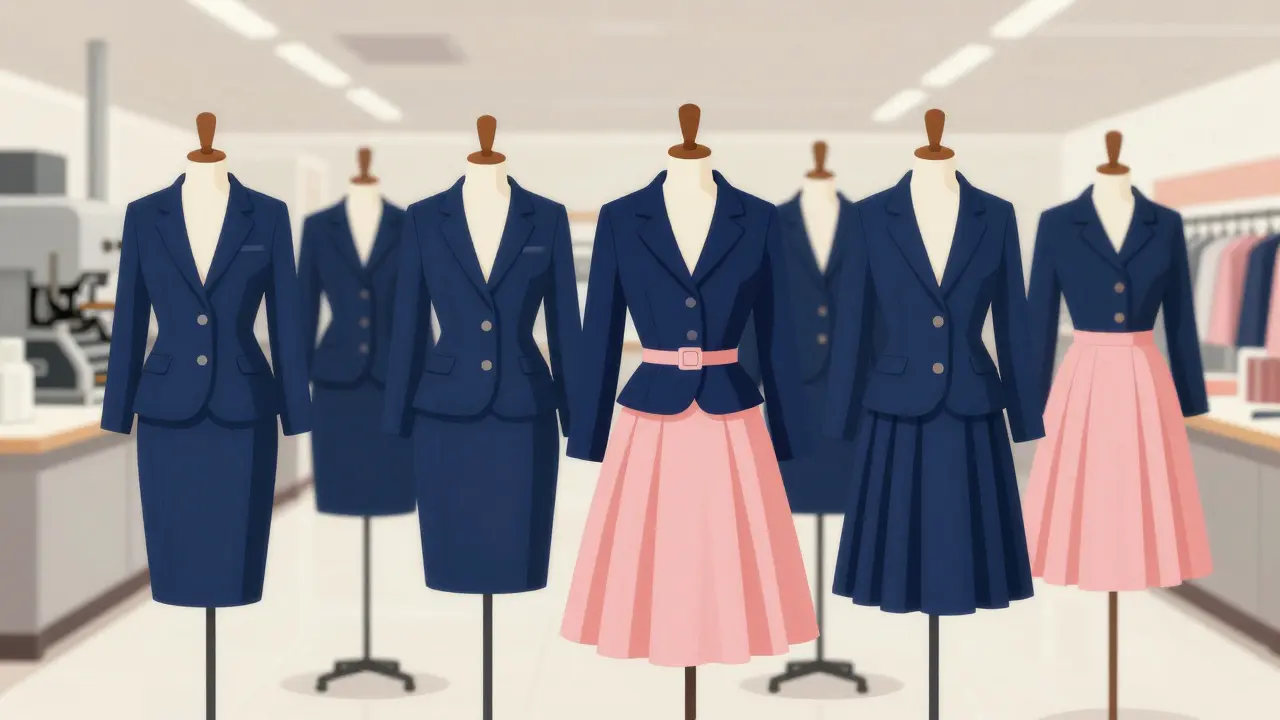
Beyond media, the actual clothes available to buy played a huge role. Before the 1940s, most clothing was custom-made or hand-sewn at home. World War II changed everything. Fabric rationing forced designers to use less material, leading to simpler, more standardized cuts. After the war, the rise of suburban shopping malls and department stores made ready-to-wear (RTW) clothing the norm.
Manufacturers needed efficiency. To produce clothes cheaply and quickly, they relied on standard sizing charts and limited color palettes. You couldn’t walk into a store and find a shirt in fifty shades of blue. You found white, light blue, or navy. You couldn’t easily alter a suit to fit your unique shoulder slope because tailoring services declined as convenience became king. This industrial standardization meant that if two men bought the same size suit from Sears, they would literally look identical because the garment was cut from the same pattern block.
For women, the situation was similar but with added pressure. The post-war economy pushed women back into domestic roles, and fashion reflected this. The "New Look" introduced by Christian Dior in 1947 emphasized a cinched waist and full skirts, requiring significant fabric and structure. While high-end versions were custom, the mass-market copies simplified these shapes into rigid silhouettes that left little room for personal variation. You either fit the mold, or you looked like you didn’t belong.
Social Conformity and the Fear of Standing Out
Clothing is never just about fabric; it’s about social signaling. In the 1950s, the United States was deeply concerned with conformity. After the chaos of the Great Depression and WWII, society craved order, predictability, and safety. Deviating from the norm wasn’t just seen as quirky; it was viewed as suspicious. During the Red Scare, being "different" could imply political disloyalty. Even outside politics, neighbors judged each other harshly. A woman who didn’t iron her husband’s shirts perfectly or a man who wore casual clothes on a Sunday risked social ostracization.
This pressure created a feedback loop. People dressed alike to signal that they were good, stable citizens. Hair salons and barbershops became centers of social control. Barbers knew exactly how to cut a "regular" fade or a side-part, and deviating from this script was rare. Hairstyles like the beehive or the pompadour required daily maintenance with heavy products like Aqua Net. These styles weren’t just aesthetic choices; they were performances of respectability. If you looked messy, you were perceived as lazy or unstable.
The Shift: Youth Culture and the 1960s Rebellion
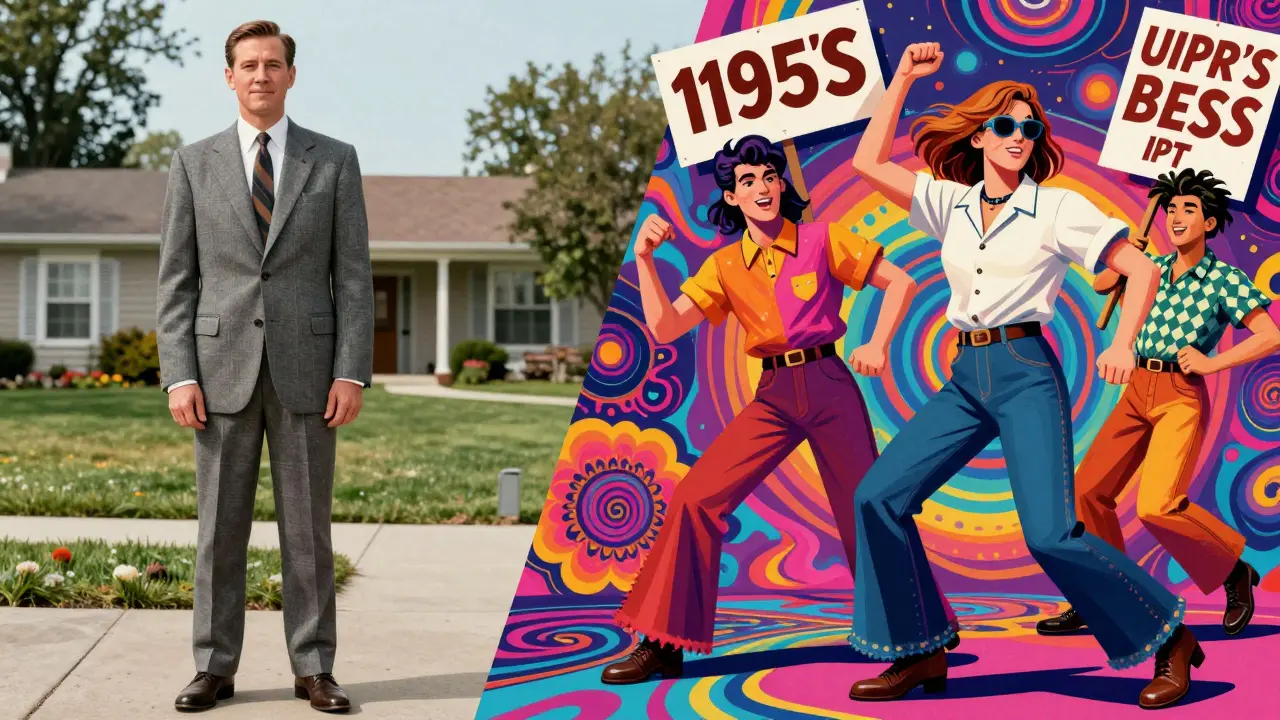
So, did everyone keep looking the same forever? No. The late 1960s marked a dramatic break from this uniformity. As baby boomers entered adolescence, they began to reject the values of their parents. Music played a pivotal role here. Rock ‘n’ roll artists like Elvis Presley initially challenged norms with his hip-shaking and leather jackets, but by the mid-60s, bands like The Beatles and The Rolling Stones introduced new looks: longer hair, collarless shirts, and psychedelic patterns.
This wasn’t just a style change; it was a political statement. The Civil Rights Movement, the anti-war protests, and the sexual revolution all demanded visibility. People wanted to express their identities, not hide them behind a uniform of suburban compliance. Fashion houses began to cater to younger demographics. Mary Quant popularized the miniskirt in London, defying traditional modesty standards. Hippies embraced tie-dye and natural fabrics, rejecting the synthetic, structured looks of the previous decade.
However, even during this shift, the "look" of the counterculture became its own kind of uniform. If you were a hippie, you wore bell-bottoms and beads. If you were a mod, you wore parkas and go-go boots. Individuality existed, but it was often expressed through affiliation with a specific subculture rather than pure personal invention. True eclectic individualism-the kind we see today where one person mixes Victorian lace with streetwear sneakers-was still rare because the supply chain couldn’t support such niche demands yet.
How This Compares to Modern Diversity
Today, we take diversity for granted. We can buy clothes online from brands in ten different countries. We can watch tutorials on how to achieve any hairstyle imaginable. But this freedom comes with its own challenges. In the 1950s, the uniformity provided a sense of belonging and clarity. Today, the sheer number of options can lead to anxiety about "getting it right."
Moreover, while we look more different on the surface, algorithms create new echo chambers. You might think you’re seeing diverse styles, but if you follow fitness influencers, you’ll see a lot of athleisure. If you follow vintage lovers, you’ll see a lot of retro fits. The monoculture hasn’t disappeared; it has just fragmented into thousands of micro-monocultures. The 1950s had one national style; we now have hundreds of niche styles, but within those niches, conformity remains strong.
Key Takeaways
- Limited Media: With only three TV channels, trends spread uniformly across the nation.
- Industrial Standardization: Ready-to-wear clothing used rigid patterns and limited colors, reducing variety.
- Social Pressure: Conformity was valued for social stability and political safety.
- Subcultural Uniforms: Even rebellion in the 60s followed distinct, recognizable dress codes.
- Modern Fragmentation: Today’s diversity is real, but algorithmic bubbles create new forms of group conformity.
Did everyone really look the same in the 1950s?
Not literally everyone, but the range of acceptable styles was extremely narrow. Social pressure and limited retail options meant that deviations from the norm were rare and often stigmatized. Most people adhered to a few dominant silhouettes for both men and women.
Why did men's hairstyles look so similar in the 60s?
Barbershops operated on strict professional standards. Styles like the side-part or the short back-and-sides were easy to maintain and signaled professionalism. Longer hair was associated with counter-culture movements and was generally frowned upon in corporate and suburban settings until the late 60s.
How did World War II affect 1950s fashion?
WWII introduced fabric rationing, which forced simpler designs. Post-war, the demand for affordable, mass-produced clothing led to the rise of ready-to-wear garments. This industrial shift prioritized efficiency and standard sizing over custom tailoring, resulting in more uniform appearances.
Was there any ethnic diversity in 1950s fashion media?
Very little. Mainstream magazines and advertisements predominantly featured white models. African American communities developed their own vibrant fashion scenes, often adapting mainstream trends with unique flair, but these styles were rarely visible in national media until the civil rights movement gained momentum.
When did fashion start to become more individualistic?
The shift began in the mid-to-late 1960s with the youthquake and counterculture movements. However, true individualism, where mixing disparate styles is common, accelerated in the 1980s and 1990s with the rise of boutique shopping and later, the internet.



michael rome
June 5, 2026 AT 22:20I find the point about industrial constraints to be quite compelling in its simplicity. It is not merely a matter of taste but of supply chain limitations that dictated the aesthetic reality for millions. When one considers the post-war economic landscape, the drive for efficiency over individuality becomes entirely logical. We often romanticize the past without realizing how rigid the structures actually were. The uniformity was a byproduct of necessity and social pressure combined.
Saranya M.L.
June 7, 2026 AT 09:47While the author attempts to present a sociological analysis, it lacks the rigorous academic depth required for such a complex historical phenomenon. The term 'monoculture' is applied somewhat superficially here. In India, for instance, fashion has always been deeply tied to regional textiles and caste structures, which this Western-centric view completely ignores. One must consider the colonial impact on global fashion standards before making broad generalizations about the 1950s. The reliance on three TV networks is a specific American anomaly, not a universal truth.
Jeanne Abrahams
June 7, 2026 AT 20:01Oh, please. As if anyone in South Africa during apartheid looked anything like those polished Americans in their magazines. We had our own version of conformity, but it was enforced by law, not just Aqua Net. The idea that everyone 'just followed the trend' is a hilarious oversimplification. Most people were too busy surviving to worry about whether their bouffant was high enough. But sure, let's blame it on NBC.
Bineesh Mathew
June 8, 2026 AT 19:51The tragedy of the human spirit is its willingness to wear the same mask as its neighbor. We traded our souls for safety, stitching our identities into the fabric of a conformist nightmare. To look alike was to be safe, to be invisible in the eyes of the state. It was a collective suicide of the ego, performed daily in front of bathroom mirrors with hairspray as the anesthetic. We are all still wearing those suits, just in different colors now.
Oskar Falkenberg
June 10, 2026 AT 16:28i think what you guys are missing is the sheer comfort of knowing exactly where you fit in the hierarchy. back then you didnt have to scroll through endless feeds wondering if your outfit was cool enough or politically correct enough. there was a script and everyone knew their lines. sure it was restrictive but it also meant you didnt have to make a million tiny decisions every morning. maybe we shouldnt be so quick to judge them because honestly sometimes i wish i could just put on the suit and go to work without thinking about it at all
Caitlin Donehue
June 11, 2026 AT 11:30I never thought about the barbershop angle before. It makes sense that professional standards would dictate personal appearance so strictly. I wonder if that pressure still exists in some form today, even if it's less visible. Maybe we just hide behind 'personal style' while still adhering to subtle norms.
Stephanie Frank
June 12, 2026 AT 17:19This article is basically saying that people in the 50s were sheep because they had limited options. Wow, groundbreaking insight. If you want to understand why people looked the same, try looking at the fact that society actively punished deviation. It wasn't a lack of creativity; it was a survival mechanism. You don't stand out when standing out gets you fired or ostracized. The modern obsession with 'individuality' is just another consumer trap anyway.
Patrick Dorion
June 14, 2026 AT 03:58It is interesting to note that the concept of 'ready-to-wear' fundamentally changed the relationship between the body and the garment. Before this era, clothing was often altered to fit the individual, creating a unique silhouette for each person. The standardization of sizing meant that the body had to conform to the clothes, rather than the other way around. This shift had profound implications for how we perceive ourselves and our place in society. We became consumers of standardized images rather than creators of personal identity.
Marissa Haque
June 15, 2026 AT 14:40Oh my gosh!! This is such a fascinating read!!! I never realized how much media influenced everything back then!!! It's crazy to think we only had three channels!!! And the part about the Red Scare?? So intense!!! I feel like we've come so far but also kind of gone backwards with algorithms!!! Who knows what's next??? 😱✨👗
Keith Barker
June 15, 2026 AT 22:42uniformity is just another word for control. we think we are free now but we are just controlled by different masters. the algorithm replaces the television network. the influencer replaces the magazine editor. nothing has really changed except the packaging.
Lisa Puster
June 17, 2026 AT 02:47the article is fine i guess but it misses the point that european fashion was always more refined and diverse than this american suburban drabness. paris set the trends new york just copied them poorly. the reason americans looked like clones is because they lacked cultural sophistication. true elegance requires nuance which was absent in the mass produced american wardrobe of the mid century. one can only imagine the horror of a parisian seeing a typical 1950s american department store display