

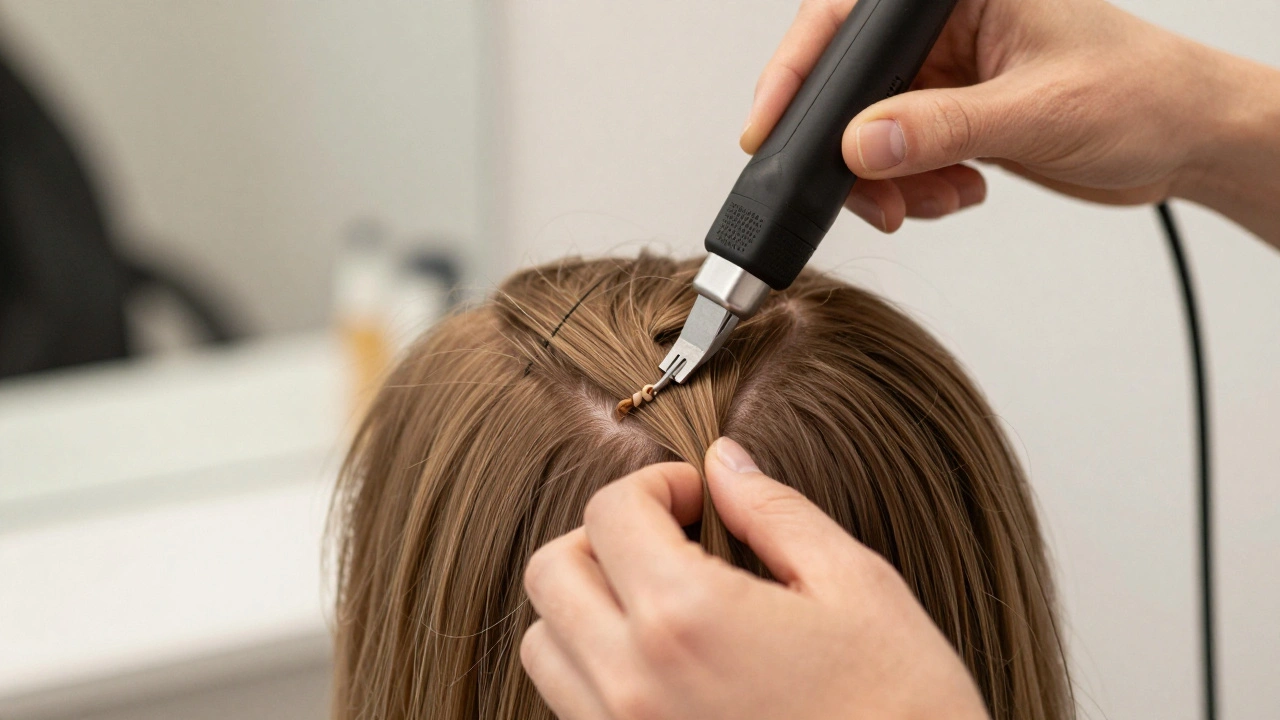
Ever seen someone with long, thick, flawless hair and wondered how they got it? If they didn’t grow it that way, chances are they’re wearing fusion hair extensions. These aren’t the clip-ins you snap on before a night out or the tape-ins that peel off after a week. Fusion extensions are meant to last. They’re attached strand by strand, bonded directly to your natural hair with heat, glue, or keratin. And if done right, they look completely natural - like your own hair grew out of your scalp.
How Fusion Hair Extensions Work
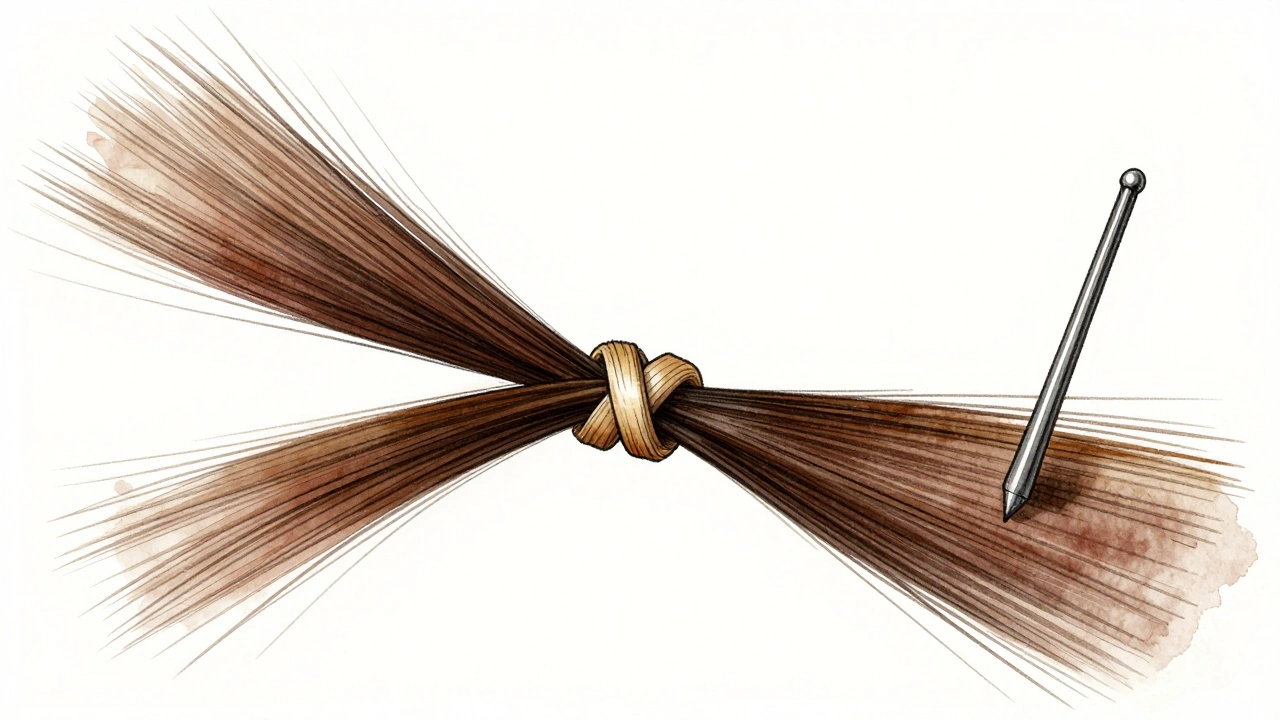
Fusion hair extensions use small keratin bonds to attach individual strands of human hair to your own hair. Each bond is about the size of a grain of rice. A stylist heats the bond with a special tool until it softens, then presses it gently against your natural hair. Once it cools, it hardens into a secure hold. The result? A seamless blend that moves and behaves like your real hair.
Unlike wefts or clips, fusion extensions don’t pull on your scalp or create bulk at the roots. Each extension is placed close to the scalp, following your natural hairline. This makes them ideal for people who want volume, length, or both - without looking like they’re wearing a wig.
The process takes about two to four hours, depending on how many strands you’re adding. Most people get between 40 and 150 strands. That’s not a lot compared to other methods, but each strand is thick and long enough to make a big difference.
What Kind of Hair Is Used?
Not all hair is created equal. High-quality fusion extensions use 100% Remy human hair. That means the cuticles are intact and aligned in the same direction. This prevents tangling and gives the hair a smooth, shiny finish. Non-Remy hair? It’s cheaper, but it tangles fast, looks dull, and can damage your natural hair over time.
Most salons source their hair from India, China, or Eastern Europe. The best quality comes from donors who haven’t chemically treated their hair. That’s why premium fusion extensions cost more - you’re paying for hair that’s clean, healthy, and durable.
Color matching matters too. A good stylist will blend multiple shades to match your natural hair’s highlights and lowlights. If your hair has subtle golden tones or ashy undertones, they’ll pick extensions that mirror that. No one wants to walk out with a head of hair that looks like it was bought at a discount store.
How Long Do They Last?
Fusion extensions last between three and six months. That’s longer than tape-ins or clip-ins, but not forever. As your natural hair grows, the bonds slowly move down the shaft. When they get about an inch away from your scalp, it’s time to get them moved up - or removed and reinstalled.
Skipping maintenance can cause problems. If the bonds stay too close to the scalp, they can pull on your hair and cause breakage. If they’re left too long, they can tangle and become impossible to remove without cutting.
Most people schedule a maintenance appointment every 6 to 8 weeks. It’s not cheap - usually $100 to $200 - but it’s cheaper than starting over. And it keeps your hair healthy.

Are Fusion Extensions Bad for Your Hair?
This is the biggest question people ask. The answer? It depends.
When done by a trained professional using quality products, fusion extensions are safe. But if you go to a salon that cuts corners - using low-grade glue, applying too much heat, or skipping aftercare instructions - you could lose hair. Permanent damage is rare, but temporary thinning isn’t.
The key is in the removal. You can’t just pull them out. A special solvent is used to dissolve the keratin bond without damaging your strands. If the stylist rushes this step, or uses the wrong product, your hair can snap or break off.
Also, don’t try this at home. DIY fusion kits are sold online, but they’re risky. Without the right tools, training, or experience, you’re more likely to burn your scalp or ruin your hair than to get a flawless look.
Who Should Get Fusion Extensions?
Fusion extensions are best for people who:
- Have enough natural hair to support the weight (at least shoulder-length)
- Want long-term results without daily upkeep
- Don’t mind spending time and money on maintenance
- Are willing to avoid heat tools and tight hairstyles
If your hair is fine, thin, or already damaged, fusion might not be right for you. The added weight can stress weak strands. Same if you have a sensitive scalp - the heat and glue can cause irritation.
People with curly or textured hair can get fusion extensions too, but they need to be careful. The extensions must match the curl pattern exactly. Otherwise, they’ll look unnatural or flip out at odd angles.
How to Care for Fusion Extensions
Treating them like your natural hair is the rule. But there are a few extra steps:
- Wash your hair 2-3 times a week. Too much shampoo breaks down the bonds faster.
- Use sulfate-free, alcohol-free shampoos and conditioners. Harsh ingredients dry out both your hair and the bonds.
- Avoid sleeping with wet hair. Dampness weakens the glue.
- Brush gently from the ends up. Start at the bottom and work your way to the roots to avoid tugging on the bonds.
- Stay away from tight ponytails, braids, or buns. They pull on the bonds and can cause slippage.
- Limit heat styling. If you must use a flat iron or curling wand, keep it under 350°F and avoid the bond area.
Also, skip swimming in chlorinated pools or saltwater without protection. Both can dry out the hair and weaken the adhesive. If you swim, wear a swim cap or rinse your hair immediately after.
How Much Do They Cost?
Prices vary by location, salon, and hair quality. In Houston, you’re looking at $600 to $1,800 for a full set. That includes the hair, installation, and sometimes the first maintenance.
Higher-end salons use European or virgin hair and charge more. Budget salons might use lower-grade hair and cut corners on application. You get what you pay for - and in this case, cheap can mean expensive later if your hair gets damaged.
Don’t be fooled by online deals. A $200 kit might seem like a steal, but you’ll need to pay a stylist to install it anyway. And if it doesn’t match your hair, you’ll have to buy new ones.
Alternatives to Fusion Extensions
If fusion sounds too intense, here are other options:
- Tape-ins: Less invasive, easier to remove. Last 6-8 weeks. Good for beginners.
- Clip-ins: Instant length, zero commitment. Best for special occasions.
- Sew-ins: Braided base with wefts sewn in. Great for textured hair.
- Micro-links: Metal beads hold strands. Less heat, easier to maintain.
Each has pros and cons. Fusion wins for natural look and longevity. But if you’re not ready for the commitment, start with tape-ins or clip-ins to test the waters.
Final Thoughts
Fusion hair extensions aren’t a quick fix. They’re a commitment - to time, money, and care. But if you want hair that looks like it’s always been there, that moves naturally, and that lasts for months, they’re one of the best options out there.
The key is choosing the right salon and stylist. Look for someone who specializes in fusion, asks about your hair history, and shows you before-and-after photos of real clients. Don’t be afraid to ask questions. A good stylist will explain every step, warn you about risks, and never push you into something you’re not ready for.
When done right, fusion extensions don’t just change your look. They change how you feel about yourself.
Can fusion hair extensions damage my natural hair?
Yes, if they’re installed or removed incorrectly. Poor technique, low-quality glue, or excessive heat can cause breakage or hair loss. But when done by a trained professional using proper products and care, fusion extensions are safe. The key is maintenance - regular touch-ups and gentle handling prevent damage.
How long does it take to install fusion hair extensions?
Installation usually takes between two and four hours, depending on how many strands you’re adding. Most people get between 40 and 150 strands. The process is slow and precise - each bond is applied one at a time to ensure a natural blend.
Can I wash my hair normally with fusion extensions?
Yes, but you need to be careful. Wash your hair 2-3 times a week using sulfate-free, alcohol-free products. Avoid scrubbing the bonds directly. Always rinse thoroughly and pat dry gently. Never sleep with wet hair - moisture weakens the adhesive.
Do fusion extensions work on curly or textured hair?
Yes, but only if the extensions match your curl pattern exactly. A stylist must select hair with the same wave, coil, or kink as your natural hair. Otherwise, the extensions will look unnatural or flip out at odd angles. Textured hair requires more expertise - find a stylist who specializes in curly or coily hair.
How often do I need to get fusion extensions maintained?
Every 6 to 8 weeks, depending on your hair growth. As your natural hair grows, the bonds move down the shaft. When they’re about an inch away from your scalp, they need to be repositioned. Skipping maintenance can cause tangles, slippage, or damage to your hair.
Can I color my hair with fusion extensions in place?
It’s possible, but risky. Bleaching or highlighting can damage the keratin bonds and weaken the extensions. If you want to color your hair, do it before getting extensions. If you must color after, only use low-ammonia, semi-permanent dyes and avoid applying color near the bonds. Always consult your stylist first.
Are fusion extensions worth the cost?
If you want long-lasting, natural-looking hair that you can style and live in like your own, then yes. They’re more expensive upfront than clip-ins or tape-ins, but they last longer and require less daily effort. For people who want to transform their hair without constant upkeep, fusion extensions offer the best balance of beauty and practicality.


Tiffany Ho
December 6, 2025 AT 14:54I got fusion extensions last year and honestly they changed my life
Used to tie my hair up all the time because it was so thin now I just let it flow
No more bad hair days
michael Melanson
December 8, 2025 AT 11:01Been thinking about getting these but scared of the damage
My hair is already fragile from coloring
Anyone else with similar concerns?
lucia burton
December 9, 2025 AT 18:03Let me break this down for you because the article skips a few critical points
Fusion extensions rely on keratin bonding technology that mimics the natural protein structure of human hair
That’s why they last longer than tape-ins which use polymer adhesives that degrade under humidity and heat
The real secret is the Remy hair sourcing - cuticle alignment prevents tangling and gives that salon-quality shine you can’t fake
And don’t even get me started on how improper removal can cause traction alopecia if the bonds aren’t dissolved properly with a professional-grade solvent
Most people don’t realize the maintenance isn’t optional - it’s biological
Your hair grows about half an inch a month so those bonds migrate and if you wait too long you’re essentially gluing your hair to itself in a spiral of breakage
It’s not just expensive - it’s a commitment to hair health
Denise Young
December 11, 2025 AT 16:09Oh so you just pay $1500 to have someone glue your hair to your scalp and then spend $200 every two months to fix the mess you made
And you call that beauty
My grandma had a wig and she looked like a queen
At least she didn’t have to worry about sulfates or sleeping with wet hair
Also why do we treat hair like it’s a car that needs regular tune-ups
Just let it be
Sam Rittenhouse
December 13, 2025 AT 09:32I’ve been a stylist for over 15 years and I’ve seen too many people ruin their hair trying to chase the perfect look
But when someone comes in with patience and the right expectations - fusion can be magic
It’s not about vanity
It’s about confidence
That moment when you turn around and your hair just… flows
Like it always had
That’s worth the investment
Just find a real specialist - not the salon that does it for $400 and uses glue from a Walmart pack
Peter Reynolds
December 15, 2025 AT 07:32I tried tape-ins first they lasted 6 weeks then fell out
Went with fusion after that
Two years later still going strong
Just follow the care rules and you’ll be fine
Don’t overwash don’t pull don’t heat the bonds
Simple
Fred Edwords
December 17, 2025 AT 05:02The article incorrectly states that fusion extensions are attached with ‘glue’ - this is inaccurate. Keratin is a protein-based thermal bonding agent, not a synthetic adhesive. Furthermore, the phrase ‘grain of rice’ is imprecise; the average bond measures approximately 3–4 millimeters in diameter, not the volume of a grain of rice. Also, the term ‘Remy hair’ must be capitalized as it is a proprietary term derived from the French word ‘remy,’ meaning ‘in order.’ Finally, the word ‘chlorinated’ is misspelled in the swimming section. Minor, but important.
Sarah McWhirter
December 18, 2025 AT 06:44Did you know that most fusion hair extensions are sourced from temples in India where women donate their hair as part of religious rituals - then it gets sold for thousands to Western salons
And you think you’re just getting ‘premium hair’
But really you’re buying into a global exploitation chain
And the ‘Remy’ label? That’s just marketing
Most of it gets mixed with synthetic fibers anyway
And the stylists? They’re trained by corporations that don’t care if your hair falls out
They just want your next payment
Wake up
It’s not beauty - it’s capitalism with a ponytail
Ananya Sharma
December 19, 2025 AT 08:59Everyone talks about how great fusion is but no one talks about the real cost - the psychological cost
You start to believe your worth is tied to how long your hair is
Then you panic when a strand falls out
Then you avoid mirrors
Then you spend hours brushing so the bonds don’t slip
And you forget what your own hair even looked like
And the worst part? You’re not even happy
You’re just trying to keep up
Meanwhile your natural hair is thinning and you’re too scared to take them out
Because now you think you’re ugly without them
And that’s not beauty
That’s addiction wrapped in keratin
kelvin kind
December 20, 2025 AT 18:39Got mine done last month. Looks great. No regrets.
Ian Cassidy
December 22, 2025 AT 07:53People don’t realize the bond migration is the real issue
It’s not just about looking bad - it’s about scalp tension
Every time you move your head the bond pulls slightly
Over time that creates microtrauma
That’s why some people get bald spots behind the ears
It’s not always from removal
It’s from daily wear
Zach Beggs
December 23, 2025 AT 17:12I’m curious - what’s the average lifespan of the extensions themselves? Like, after removal, can the hair be reused?
Kenny Stockman
December 24, 2025 AT 18:51Hey I’m a guy and I got these last year
Yeah I know - weird right
But I had thinning on top and it’s like night and day now
People think I just grew it out
No one knows
And I don’t tell them
It’s my little secret
Best decision I ever made