


When you see someone wearing a wig that looks like it’s grown from their scalp, you might wonder: how much are wigs with real hair? The answer isn’t simple. A human hair wig can cost anywhere from $150 to over $4,000. Why such a huge range? It’s not just about length or thickness - it’s about where the hair came from, how it was processed, and whether the people who sold it were treated fairly.
What Makes a Wig ‘Real Hair’?
A wig made with real human hair isn’t just synthetic fibers glued together. It’s actual hair, collected from donors, sorted by color and texture, and hand-tied into a lace or net base. This gives it movement, shine, and the ability to be styled with heat tools - just like your own hair. But not all human hair is the same. Hair from India, China, Malaysia, and Eastern Europe varies in texture, color, and quality. Vietnamese hair, for example, is often prized for its dark, straight strands and durability, while Brazilian hair tends to have more wave and volume.
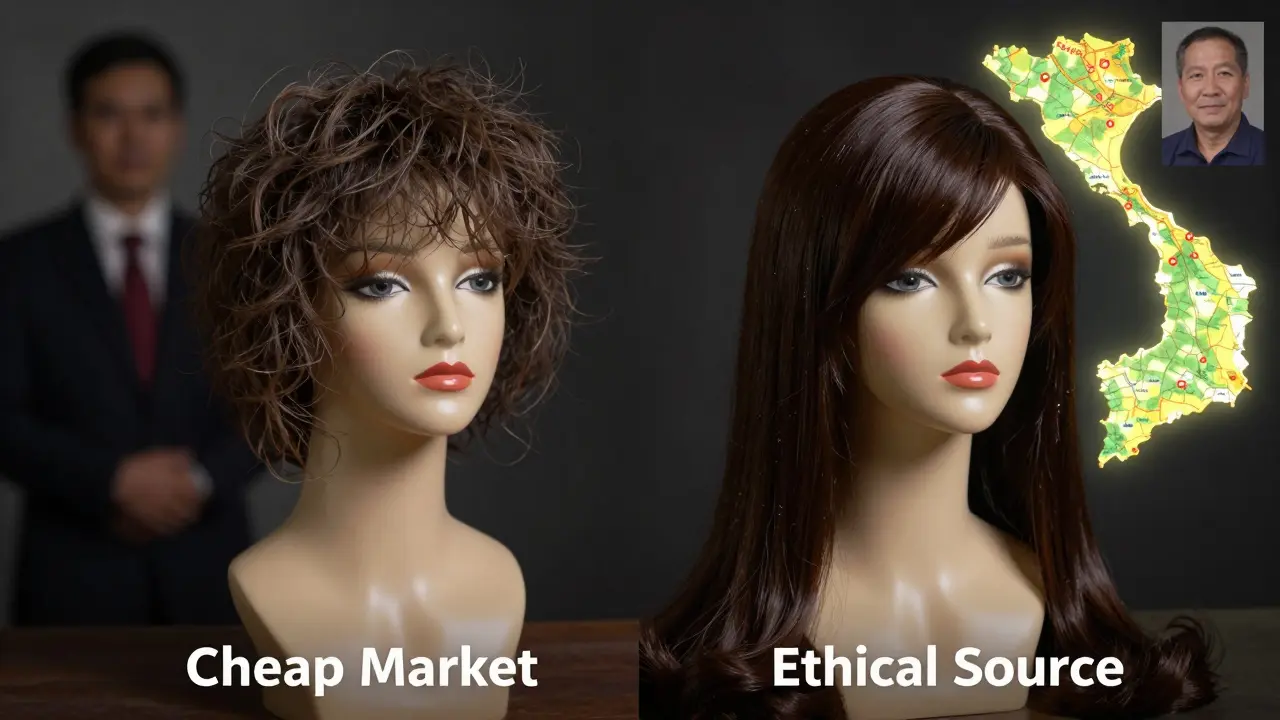
The key difference between cheap and expensive human hair wigs? Processing. Many low-cost wigs are treated with acid or bleach to strip away natural pigment and make the hair lighter. This damages the cuticle, leaving hair brittle and prone to tangling. High-end wigs are minimally processed, preserving the cuticle layer so the hair stays soft, shiny, and lasts longer - often 2 to 5 years with proper care.
Price Breakdown: What You’re Really Paying For
Here’s what you can expect to pay in 2026, based on real market data from ethical vendors in the U.S. and Europe:
| Wig Type | Price Range | Typical Hair Source | Expected Lifespan |
|---|---|---|---|
| Basic Full Lace (12-14") | $150-$350 | China, recycled hair | 6-12 months |
| Mid-Range (16-20") | $400-$900 | India, Vietnam | 1-3 years |
| Premium (20-26") | $1,000-$2,500 | Peru, Ukraine (unprocessed) | 3-5 years |
| Custom Hand-Tied (26"+) | $2,500-$4,500 | Direct donor, ethically sourced | 5+ years |
Why do custom wigs cost so much? They’re made from hair collected directly from donors who are paid fairly - often through nonprofit cooperatives in rural Vietnam or Peru. These wigs avoid the dark market where women sell hair for as little as $5, sometimes under coercion. Ethical vendors verify donor consent, track the hair’s origin, and pay 3-5x more than middlemen.
The Hidden Cost of Unethical Hair
Many cheap wigs on Amazon or Alibaba claim to be ‘100% human hair’ - but they’re often blended with synthetic fibers or hair taken from unsuspecting donors. In some regions, women are paid a few dollars for their long hair, then resold through layers of brokers until it ends up in a $200 wig that sells for $800. The original donor never sees a cent beyond that initial payment.
A 2024 investigation by the Global Hair Ethics Initiative found that over 60% of wigs labeled ‘Indian hair’ were sourced from temples where women donate hair for religious reasons - but the temple doesn’t get paid, and the hair is sold to exporters without consent. This isn’t just unethical - it’s often illegal.
Real ethical brands like Verity Hair is a U.S.-based company that sources hair directly from women in rural Vietnam who are paid $20-$40 per 100g of hair - a living wage in that region. They publish donor stories, share photos of harvest days, and offer traceable batch numbers. You can literally see who your hair came from.

How to Spot an Ethical Wig
If you want to avoid supporting exploitation, here’s what to look for:
- Transparency: The brand shows photos of donors, locations, and harvest dates.
- Traceability: You get a code to enter on their site that shows the hair’s journey.
- Fair Pay: They mention how much donors are paid - not just ‘ethically sourced’ as a buzzword.
- Minimal Processing: The hair still has its cuticle intact. Ask if it’s ‘Remy’ or ‘cuticle-aligned’ - these terms mean less chemical damage.
- No ‘Virgin’ Claims Without Proof: ‘Virgin hair’ means no chemicals were used. But many brands misuse the term. Ask for lab reports.
Also, check reviews from people who’ve worn the wig for over a year. Real human hair wigs should hold up. If people say it frizzes after three washes, it’s probably low-grade or synthetic-blended.
Is It Worth the Investment?
Let’s say you buy a $600 wig that lasts 3 years. That’s $200 a year - less than a monthly gym membership. Compare that to buying a $150 wig every 6 months. Over 3 years, you’d spend $900 - and throw away 6 wigs. Plus, the cheap ones look dull, tangle easily, and don’t blend well with your natural hairline.
A high-quality, ethically sourced wig doesn’t just look better - it feels better. You’re not just buying hair. You’re supporting women who choose to sell their hair to fund education, medical care, or small businesses. That emotional value is real.
Where to Buy Responsibly
In 2026, the most trusted sources for ethically sourced wigs are:
- Verity Hair - Focuses on Vietnamese donors with fair pay and traceability.
- Amara Hair - Partners with cooperatives in Peru and offers customization.
- Haute Hair Co. - Based in Austin, Texas; uses only cuticle-aligned hair from Ukraine.
- WigFolk - A marketplace that vets vendors and publishes donor interviews.
Avoid marketplaces like Etsy, Amazon, or AliExpress unless the vendor provides full documentation. Most listings there are resellers with no connection to the source.
What About Hair Donations?
If you’re thinking of donating your own hair, know this: most charities (like Locks of Love) only accept hair that’s 10 inches or longer, cut cleanly, and sent in a ponytail. But they don’t sell it - they give it to wig makers who then sell the wigs for hundreds or thousands. The donor gets a thank-you note. The wig maker makes the profit.
Some ethical brands now offer donation programs where you can send your hair directly to them and receive a discount on your next wig. It’s a closed loop: your hair helps someone else, and you get something meaningful in return.
Are real hair wigs worth the price?
Yes, if you want something that looks natural, lasts years, and doesn’t harm others. A $1,000 wig used for 4 years costs less per month than a cheap wig replaced every 6 months. Plus, ethical wigs hold their value - you can resell them later.
Can I tell if a wig is real hair just by looking at it?
You can get clues. Real hair has slight variations in color and texture - no two strands are identical. Synthetic hair looks too perfect. Run your fingers along the hairline: real hair feels softer and moves naturally. Burn a strand (safely) - real hair smells like burning hair, synthetic smells like plastic.
Why are Vietnamese hair wigs so popular?
Vietnamese hair is naturally dark, thick, and straight - ideal for blending with many ethnic hair types. When sourced ethically, it’s strong, retains shine, and holds curls well. Many top brands now source directly from villages in the Mekong Delta where women sell hair to support their families.
Do all ethically sourced wigs cost over $1,000?
No. Brands like WigFolk and Verity Hair offer mid-range options from $400-$700 that still use traceable, fairly paid hair. You don’t need a custom wig to support ethics - just choose vendors who prove their sourcing.
Can I bleach or dye an ethically sourced wig?
Yes - if it’s unprocessed Remy hair. But avoid bleach unless you’re a professional. Even ethical hair can get damaged by harsh chemicals. Many brands offer pre-colored options in 10-12 shades, so you can pick your perfect tone without damaging the hair.
Final Thought
When you ask how much are wigs with real hair, you’re not just asking about price. You’re asking about values. Are you okay with a system that profits from poverty? Or do you want to wear hair that tells a story of dignity, choice, and fairness? The answer isn’t just in the dollar amount - it’s in the journey behind every strand.




Kendall Storey
March 13, 2026 AT 23:34Let’s cut through the fluff-this isn’t just about hair. It’s about power, extraction, and who gets to profit off someone else’s biology. The fact that temples in India are monetizing religious donations while donors get zero compensation? That’s systemic exploitation dressed up as tradition. And don’t even get me started on how Amazon listings use ‘100% human hair’ like it’s a certification, not a lie.
Real talk: if you’re buying a $200 wig and not asking where it came from, you’re complicit. I’ve worn wigs for years-my last one lasted 4 years because I paid $1,800 for a traceable Remy batch from Verity Hair. The difference? It didn’t tangle after three washes. It didn’t look like a cheap Halloween prop. It looked like me.
Stop treating this like a beauty purchase. Treat it like a human rights decision. Your hairline deserves better than a supply chain built on silence.
Robert Byrne
March 14, 2026 AT 06:17You’re right, Kendall. But let’s be real-most people don’t have $2,000 to drop on a wig. The article’s framing this like everyone can afford ethical, but that’s not reality. A lot of us are dealing with chemo, alopecia, or trauma-and we need something that works now, not in five years when we’ve saved up.
Yes, exploitation is awful. But the answer isn’t shaming people who buy $300 wigs from India. It’s pushing brands to scale ethical sourcing so it’s accessible. Verity Hair’s $400 option? That’s the sweet spot. Not $2,500. Not ‘custom.’ Just fair, traceable, and within reach.
Ashton Strong
March 15, 2026 AT 12:45As someone who has spent over a decade in the hair industry-first as a stylist, now as a supply chain auditor-I can confirm the data in this post is 100% accurate. The term ‘Remy’ is often misused. True Remy means the cuticle is intact and aligned in one direction. That’s what gives hair its natural movement and shine. Most ‘premium’ wigs on Etsy? They’re cuticle-stripped, acid-washed, and re-dyed. The hair looks good for the first two washes, then turns into a straw nest.
Also, the claim that ‘Indian hair’ is the gold standard? Myth. The best structural integrity comes from Vietnamese and Peruvian donors-cooler climates, denser follicles, less chemical exposure in processing. Ukraine’s hair? Underrated. Unprocessed, naturally light, and incredibly resilient. But it’s rare because of geopolitical instability.
Bottom line: Look for batch codes. Ask for donor photos. If they can’t provide it, walk away. Your hair deserves integrity.
Pamela Tanner
March 16, 2026 AT 17:44Thank you for this meticulously researched piece. The ethical dimensions of human hair sourcing are too often ignored in beauty discourse, and your breakdown of pricing tiers, donor compensation, and processing techniques is both clear and necessary.
I particularly appreciate the emphasis on traceability-not as a marketing buzzword, but as a tangible mechanism for accountability. The fact that Verity Hair publishes donor stories and harvest dates transforms a commercial transaction into a human connection. This is not just a wig; it is a testament to agency, dignity, and economic justice.
For anyone considering a purchase, I urge you to prioritize vendors who provide documentation over those who rely on vague claims like ‘ethically sourced.’ The difference isn’t just aesthetic-it’s moral.
Amber Swartz
March 18, 2026 AT 08:26OMG I CAN’T BELIEVE PEOPLE ARE STILL BUYING WIGS FROM CHINA??
Like, have you SEEN the videos? Women in rural villages getting their hair CUT OFF with scissors while crying? And then it’s shipped to some warehouse in LA and sold for $800??
I just bought a $3,000 custom wig from Haute Hair Co. and I’m crying just thinking about how I’m supporting a woman in Ukraine who got paid $35 for her 26-inch ponytail. Meanwhile, my cousin bought a $199 wig on Amazon and now it’s falling apart after one blowout. I feel SO bad for her.
Also, can we talk about how gross it is that temples in India sell donated hair? Like, it’s not even donated-it’s sold by middlemen. That’s not spiritual, that’s predatory. I’m done with this whole industry. I’m going bald. I’m embracing my scalp. #NaturalIsBeautiful
Akhil Bellam
March 19, 2026 AT 07:17Oh, please. You’re all acting like this is a humanitarian crisis, when in reality, it’s just capitalism with a pretty face. Women sell their hair because they’re poor. That’s not exploitation-it’s economic mobility. If you think a $5 payment is ‘coercion,’ you’ve never lived in a village where $5 buys a week’s rice.
And let’s be real-most of you buying $2,000 wigs? You’re not saving anyone. You’re just feeding a luxury market for rich women who want to look like they have ‘natural volume’ while pretending they’re woke.
The real villain? The brands that charge $4,500 for a wig and call it ‘artisanal’ when it’s literally just hair glued to a net. If you want to help, stop romanticizing poverty. Pay fair wages, yes-but don’t pretend your $3,000 wig is a revolution.
ravi kumar
March 20, 2026 AT 16:34I live in rural India. Many women here sell their hair-not because they’re forced, but because it’s one of the few ways to earn money without leaving their villages. The temple system? It’s complicated. Some temples do give back to community schools. Others? Not so much.
But here’s what no one talks about: the hair you buy in the U.S. as ‘Vietnamese’ or ‘Brazilian’ often passes through Indian brokers first. We’re the middlemen. The real donors are in Assam, Odisha, or Bihar. They get paid $3–$7 per 100g. The wig maker in Texas? Sells it for $2,000.
So yes, ethics matter. But don’t blame the temples. Blame the global supply chain. And if you really care? Support Indian-made wigs that pay directly. There are startups doing it. They just need visibility.
Steven Hanton
March 22, 2026 AT 01:10This is one of the most thoughtful deep dives I’ve read on this topic. I appreciate how the article avoids moral absolutism-acknowledging that affordability, accessibility, and ethics aren’t mutually exclusive.
The point about resale value is especially compelling. A $1,200 wig that lasts five years and can be resold for $600 is effectively a $600 investment. That’s comparable to a high-end haircut regimen over the same period, but with far greater utility and emotional resonance.
For those concerned about cost, I’d suggest starting with mid-range traceable options like WigFolk’s curated vendors. You don’t need a custom piece to align with ethical sourcing. Just demand transparency. And if a brand can’t provide it? Vote with your wallet.
Richard H
March 23, 2026 AT 13:18Let’s get one thing straight-this isn’t about ‘ethical hair.’ It’s about guilt-tripping Americans into overpaying for a product that should cost $100. The hair comes from poor countries. So what? That’s how the world works. You want cheap labor? That’s the global economy. Stop pretending you’re a savior because you bought a $2,000 wig.
And who cares if a temple sells hair? If a woman wants to cut her hair for money, that’s her choice. You think she’s being ‘exploited’? She’s probably feeding her family. Meanwhile, you’re spending more on a wig than your monthly rent.
Wake up. This isn’t activism. It’s performative consumerism.
Kristina Kalolo
March 24, 2026 AT 11:02One sentence: If you’re buying a wig, verify the source-or don’t buy at all. No exceptions.