

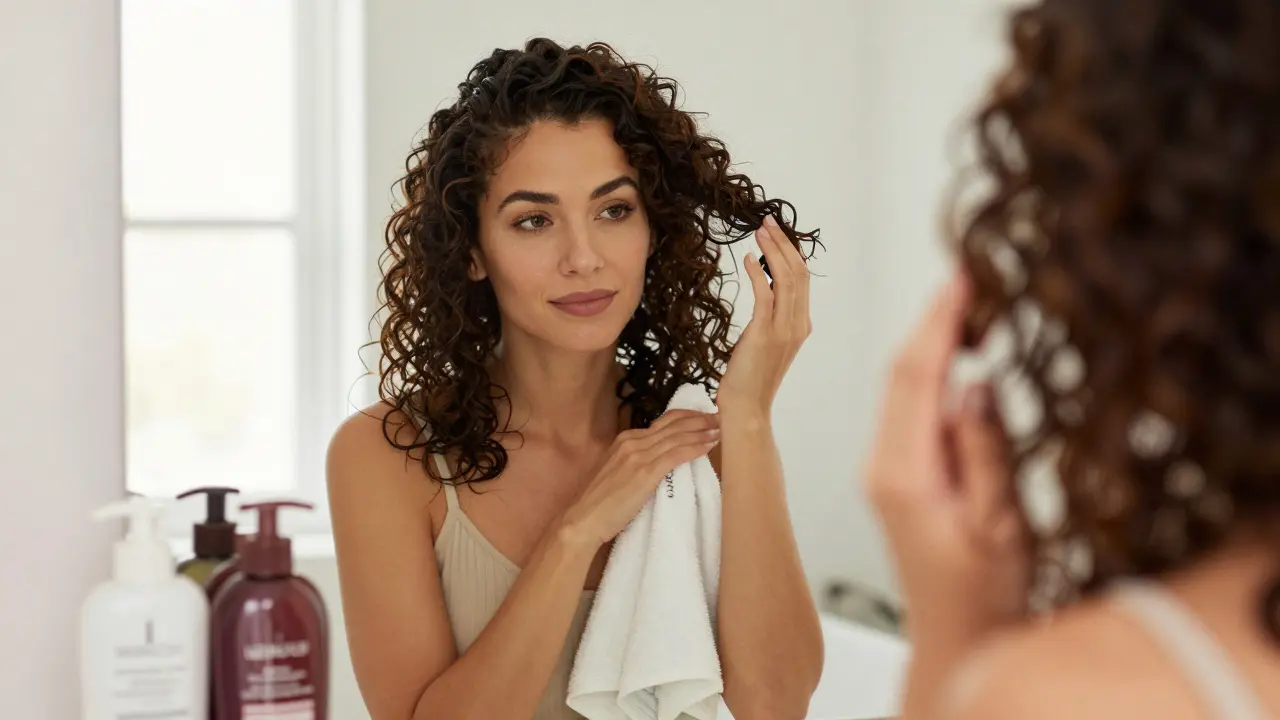
Styling curly hair isn’t about fighting your natural texture-it’s about working with it. If you’ve ever looked in the mirror after washing your hair and felt like your curls vanished into a frizzy mess, you’re not alone. The truth is, most people with curly hair have been told to straighten it, tame it, or hide it. But the best way to style curly hair? It’s simple: hydrate, define, and dry with care.
Start with the Right Wash Routine
Your curls thrive on moisture, not stripping. Many people with curly hair wash too often with sulfates, which strip natural oils and leave curls dry and brittle. Skip the sulfate shampoos. Instead, use a sulfate-free cleanser or try co-washing (conditioner-only washing) once a week. Your scalp might feel weird at first, but in a few weeks, it adjusts and produces just enough oil to keep curls soft and springy.Conditioning is non-negotiable. Always use a rich, creamy conditioner and leave it on for at least 5 minutes. For extra hydration, do a deep conditioning treatment once a week. Look for ingredients like shea butter, aloe vera, glycerin, and panthenol. These aren’t just buzzwords-they’re the building blocks of healthy curls.
Apply Products on Soaked Hair
The moment you step out of the shower, your hair is at its most absorbent. That’s your window. Drip-dry for 30 seconds, then apply products while your hair is soaking wet. Start with a curl cream or gel-these are your definition tools. Use a coin-sized amount for short hair, and double it for longer or thicker curls.Don’t just slap it on. Use the praying hands method: smooth the product between your palms, then gently press it into sections of your hair from root to tip. This helps clump curls together instead of scattering them. For tighter curls (3C-4C), a leave-in conditioner before the cream adds extra slip and softness.
Dry with a Microfiber Towel or T-Shirt
Towels with loops? Avoid them. They’re rough on curls and cause frizz. Instead, use a microfiber towel or an old cotton T-shirt. Gently scrunch your hair to remove excess water. Don’t rub. Don’t twist. Just squeeze. This step alone can cut down drying time and reduce frizz by half.Use a Diffuser (Not a Regular Blow Dryer)
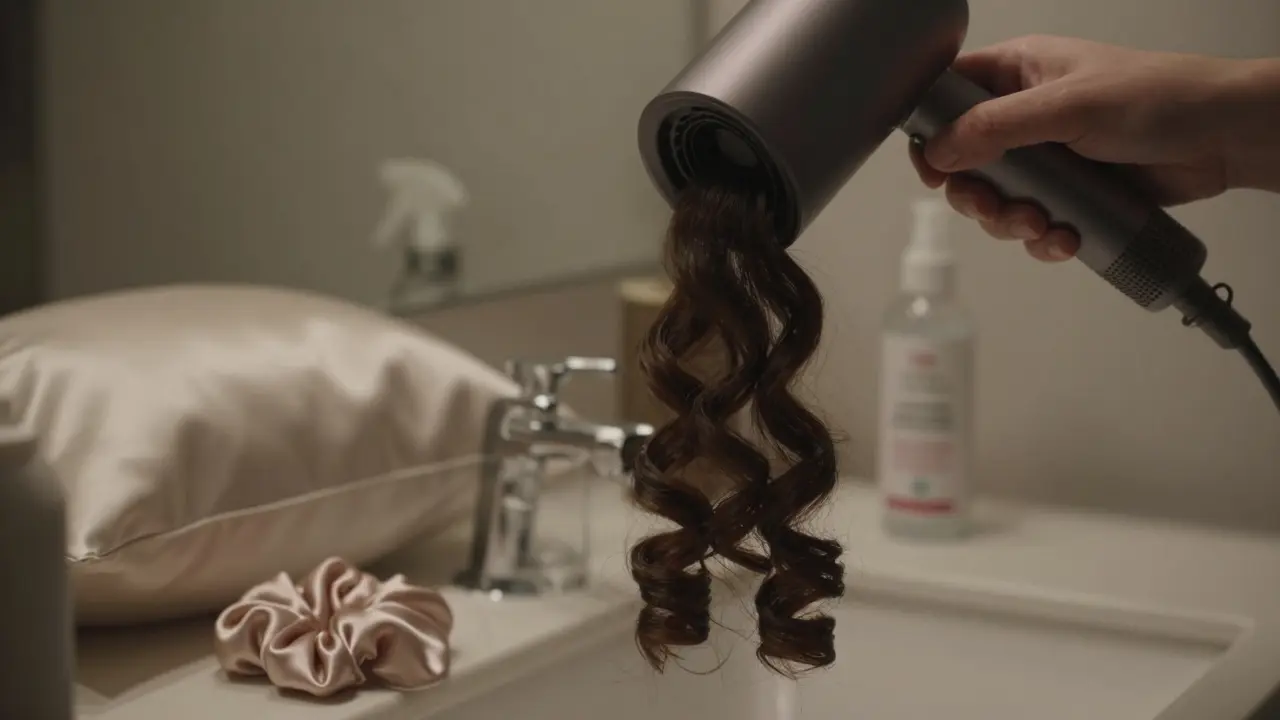
A regular blow dryer on high heat is the enemy of curly hair. It stretches curls, dries them unevenly, and creates that dreaded halo of frizz. A diffuser changes everything. It spreads air gently around your curls, letting them dry in shape.Set your dryer to low heat and medium speed. Hold the diffuser close to your head and lift sections of hair one at a time. Let the curls fall into the bowl of the diffuser naturally. Don’t touch them while they’re drying. If you’re in a hurry, dry only the roots and let the rest air-dry. Most people with curls finish drying in 15-20 minutes with a diffuser.
Try the Pineapple Method for Overnight Protection
If your curls lose definition by morning, you’re probably tossing and turning on a cotton pillowcase. Cotton absorbs moisture and tangles curls. The pineapple method fixes this. Before bed, gather your hair into a high, loose ponytail on top of your head-like a pineapple. Use a silk or satin scrunchie. This keeps your curls elevated and prevents flattening.Pair this with a silk or satin pillowcase. It reduces friction, keeps moisture in, and stops breakage. You’ll wake up with bouncier curls and less frizz. No brushing needed. Just gently scrunch with a little water or curl refresher.
Don’t Touch Your Hair While It’s Drying
This is the #1 mistake people make. Every time you touch your hair while it’s drying, you disrupt the curl formation. That’s why your curls look messy after they dry. Let them be. If you need to check, do it under the shower with water running. Or wait until they’re 80% dry before lightly scrunching. Resist the urge to poke, flip, or smooth. Your curls know what they’re doing.Refresh, Don’t Rewash
You don’t need to wash your hair every day. In fact, washing too often dries out curls. On day 2 or 3, refresh with a spray bottle of water mixed with a drop of leave-in conditioner. Spritz, then scrunch. That’s it. You can add a tiny bit of curl cream if your curls feel dry. Most people go 3-4 days between washes with this method.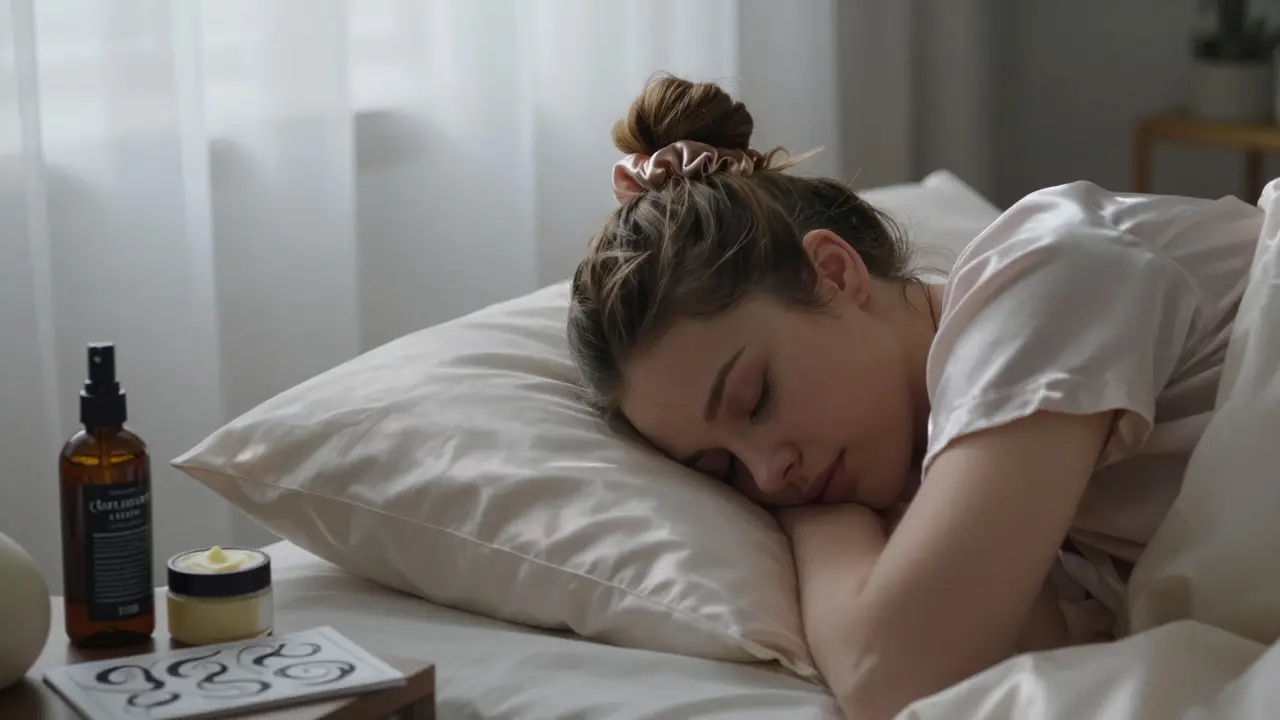
What Products Actually Work?
Not all curl products are created equal. Here’s what to look for:- Curl creams: Best for medium to thick curls. They hold shape without crunch.
- Curl gels: Ideal for definition and hold. Look for alcohol-free formulas.
- Leave-in conditioners: Essential for moisture. Apply before styling.
- Oil serums: Use sparingly on ends only. Coconut oil, argan oil, or jojoba oil work well.
- Lightweight mousses: Good for fine curls that need volume without heaviness.
Avoid products with silicones (dimethicone, cyclomethicone) unless you’re doing a clarifying wash weekly. They build up and make curls feel greasy or limp.
Common Mistakes to Avoid
- Using brushes on wet curls-they pull curls apart and cause breakage.
- Applying product to dry hair-it won’t absorb properly.
- Skipping the diffuser and using high heat-it stretches and damages curls.
- Washing with hot water-it opens the cuticle and strips moisture.
- Not using a silk pillowcase-it increases friction and frizz.
Why Your Curls Look Different Than Others
Curl patterns vary wildly. Type 2 (wavy) needs lighter products. Type 3 (springy curls) thrives on cream and gel. Type 4 (coily) needs heavy moisture and sealing with oils. Your curl type dictates your routine. Don’t copy someone else’s regimen blindly. What works for a friend with 3B curls might turn your 4A coils into a crunchy mess.Try the curl typing chart (available from curl experts like Curly Girl Method or NaturallyCurly.com) to identify your type. Once you know it, you can tailor your products and techniques. It’s not about perfection-it’s about consistency.
Final Tip: Be Patient
Styling curly hair isn’t a quick fix. It takes weeks to figure out what your hair needs. You might go through a phase where your curls look worse before they get better. That’s your scalp adjusting to less shampoo. Or your hair rebuilding its moisture balance. Stick with it. The results aren’t instant, but they’re worth it.Healthy curls are bouncy, defined, and full of life. They don’t need to look like a salon blowout. They just need to be cared for with patience and the right tools. And when you get it right? You won’t want to go back.
Can I use a regular blow dryer on curly hair?
Using a regular blow dryer without a diffuser can stretch and frizz curly hair. The high heat and direct airflow disrupt curl formation. If you must use a blow dryer, always attach a diffuser and use low heat with medium speed. Never point the nozzle directly at your curls-let the air flow around them instead.
How often should I wash curly hair?
Most people with curly hair wash every 3 to 7 days. Washing too often strips natural oils, leading to dryness and frizz. Co-washing (using only conditioner) between shampoos helps maintain moisture. If your scalp gets oily, try applying conditioner to the roots and shampoo only to the mid-lengths and ends.
What’s the difference between curl cream and gel?
Curl cream gives soft hold and moisture, making it ideal for medium to thick curls that want definition without stiffness. Gel provides stronger hold and shine, perfect for defining tight curls and reducing frizz. Many people use both: cream for moisture, gel for hold. Apply cream first, then gel on top.
Why do my curls look frizzy after they dry?
Frizz after drying usually means your hair lost moisture or was disturbed while drying. Touching curls too much, using the wrong towel, or skipping leave-in conditioner can cause this. Try the pineapple method at night, use a silk pillowcase, and apply products while your hair is soaking wet. Also, check your products-alcohol and sulfates can dry out curls.
Do I need to trim my curls regularly?
Yes, but not as often as straight hair. Curly hair is more prone to dry ends and split ends because natural oils don’t travel easily down the curl. Trim every 8 to 12 weeks if you notice dryness or splitting. You don’t need to cut a lot-just enough to remove damaged ends. This helps your curls look fuller and healthier overall.


Amy P
March 18, 2026 AT 07:27OMG YES. I went through a phase where I thought my curls were broken-turns out I was just using a terrycloth towel and a regular blow dryer like a savage. The first time I used a microfiber towel and a diffuser? I cried. Not because I was sad-because my hair looked like a halo of spring rain. I haven’t looked back. Also, pineapple method? Life-changing. I sleep like a queen now, and my curls wake up ready to party.
Ashley Kuehnel
March 18, 2026 AT 14:28YES! I'm a stylist and I see so many people struggling with curls because they're using the wrong products. Seriously-skip the silicones unless you're doing a clarifying wash every week. I always tell clients: if your hair feels greasy or weighed down after a wash, it's probably buildup. Try a baking soda rinse once a month (1 tbsp in 1 cup water) to reset. And leave-in conditioner? Non-negotiable. Even on day 3, a spritz of water + a drop of leave-in = instant revival. You don't need to buy fancy brands-look at the ingredient list, not the price tag.
Colby Havard
March 19, 2026 AT 00:07While the advice presented here is, on the surface, reasonable-indeed, even laudable-it betrays a fundamental epistemological flaw: the assumption that 'curl care' can be systematized into a universal protocol. The human body, particularly in its biological manifestations, resists categorization. To prescribe a single regimen-'hydrate, define, dry with care'-as if it were a mathematical theorem, is to ignore the phenomenological uniqueness of each individual’s follicular architecture. There is no 'best way.' There is only the path one stumbles upon after years of trial, error, and existential despair.
Furthermore, the recommendation to 'use a coin-sized amount' of product is absurdly reductive. A 'coin' varies by denomination, by country, by inflation rate. Is it a U.S. quarter? A Euro cent? A Canadian loonie? The lack of specificity here undermines the entire pedagogical framework.
And yet-despite these philosophical inconsistencies-I do appreciate the emphasis on moisture. Moisture, after all, is the only true constant in an otherwise chaotic universe.
Mongezi Mkhwanazi
March 19, 2026 AT 12:07You people are so naive. You think curl care is about products and techniques? No. It’s about control. The beauty industry has spent decades convincing women-especially women of color-that their natural texture is a defect that needs fixing. You’re being sold a dream: 'beauty through conformity.' The truth? Your curls are not a problem to be solved-they are a rebellion. Every time you follow a 'routine' dictated by influencers and corporate blogs, you’re participating in your own erasure. The pineapple method? That’s not protection-it’s assimilation. You’re still trying to look 'neat.' You’re still trying to please. Real liberation? Stop washing. Stop conditioning. Stop styling. Let your hair grow wild. Let it tangle. Let it knot. Let it be ugly. That’s when you’re free.
And don’t get me started on 'curl typing.' That’s just another way to box people in. Type 2? Type 3? Type 4? Who decided that? A white woman with a clipboard in a salon in Ohio? Your curl pattern is not a taxonomy. It’s a statement. And if you’re not screaming it from the rooftops, you’re still whispering.
Mark Nitka
March 21, 2026 AT 10:37I’ve been following this advice for 8 months now. I used to hate my hair. Now? I love it. I don’t care if it’s 'perfect.' I care that it’s healthy. I used to wash daily, use heat, brush it dry-total disaster. Now I co-wash twice a week, use a curl cream + gel combo, diffuser on low, and sleep on satin. My curls have never looked better. I didn’t need a 10-step routine. I just needed to stop fighting. This isn’t magic. It’s just common sense. And yeah, I still mess up sometimes. But I’m learning. And that’s enough.
adam smith
March 23, 2026 AT 03:53Good advice. Simple. Clear. No fluff. I’m a guy with loose waves, and I never knew what to do. I just used shampoo and conditioner like everyone else. Now I use a leave-in, scrunch with a t-shirt, and let it air dry. It’s not perfect, but it’s better. I don’t need a whole system. Just a few things. Thanks.
Kelley Nelson
March 23, 2026 AT 20:33I find it somewhat… quaint, that this entire discourse hinges on the assumption that 'curl care' is a legitimate domain of expertise. One might argue that the entire aesthetic movement surrounding curly hair is merely a symptom of late-stage consumerist identity construction. The notion that one must purchase specific products-curl creams, diffusers, satin pillowcases-is, in my estimation, a thinly veiled mechanism of capitalist extraction. And yet, I must concede: the science of hygroscopic polymers in hair care is, undeniably, fascinating. One wonders, however, whether the pursuit of 'defined curls' is a form of self-erasure disguised as self-expression.
Aryan Gupta
March 25, 2026 AT 02:05Let me tell you something you won’t hear in these 'curl care' blogs. The entire curly hair movement was created by Big Beauty to sell you $40 creams so you’ll stop asking why your hair is frizzy. They don’t want you to know that your curls are actually a sign of dehydration from tap water. The fluoride and chlorine in your shower? That’s what’s killing your hair. Buy a shower filter. That’s it. No creams. No diffusers. Just clean water. And stop using silk pillowcases-they’re made by child labor in China. I’ve been researching this for 12 years. I’m the only one who knows the truth. You’re all being manipulated.
Fredda Freyer
March 27, 2026 AT 01:18There’s something deeply poetic about the way curls behave-how they refuse to conform, how they rise and fall like waves in a tide we can’t predict. We spend so much time trying to 'manage' them, as if nature itself were a mistake to be corrected. But what if the frizz isn’t a flaw? What if it’s the signature of our resilience? The curl doesn’t ask for permission to exist. It simply is. And perhaps, in learning to care for our curls, we’re really learning to stop fighting ourselves. The routine isn’t about beauty-it’s about surrender. To moisture. To time. To the quiet, stubborn truth that some things can’t be tamed. They can only be held.
Peter Reynolds
March 28, 2026 AT 08:41Just wanted to say the part about not touching your hair while it dries changed everything for me. I didn’t realize I was doing it constantly. Now I just sit still and wait. It’s weirdly meditative. My curls are softer. Less frizzy. I still mess up sometimes but I’m trying. Thanks for the reminder.
Fred Edwords
March 29, 2026 AT 11:17Minor grammatical correction: The phrase 'drip-dry for 30 seconds' should be hyphenated as 'drip-dried' when used as a past participle. Also, 'praying hands method' is a colloquialism; it might be more accurate to refer to it as 'the palm-pressing technique.' Furthermore, the term 'pineapple method' is trademarked by a specific brand-though widely adopted, it may be considered proprietary. Precision matters.
Colby Havard
March 29, 2026 AT 17:51And yet, despite the elegance of the above rebuttals, I find myself compelled to return to the central paradox: If curl care is an act of self-acceptance, then why does the community insist on such rigid protocols? Why must one follow the 'rules' of the Curly Girl Method, the DevaCurl doctrine, the Ouidad gospel? Is not the truest form of liberation the abandonment of all systems? The curl that defies categorization-the one that refuses cream, gel, diffuser, and satin-is the only curl that is truly free.