


People have asked for centuries if the mind can change the body in ways science doesn’t fully explain. One question that keeps popping up is: Can I change hair color through meditation? The short answer? No. But the reason why people ask-and why it’s worth exploring-is far more interesting than a simple no.
What science says about hair color
Your hair color is determined by melanin, a pigment produced by cells called melanocytes in your hair follicles. The amount and type of melanin-eumelanin for brown/black, pheomelanin for red/yellow-is controlled by your genes. Once a hair strand grows out of the follicle, it’s dead tissue. No amount of thought, breathing, or visualization can alter the pigment inside it.
Studies from the National Institutes of Health show that graying hair is linked to the gradual loss of melanocyte stem cells over time. This process is influenced by genetics, age, and sometimes stress, but not by conscious mental practices like meditation. Even in cases where stress has been tied to accelerated graying, reversing it requires reducing cortisol levels long-term-not focusing on a specific color during meditation.
Why do people believe meditation can change hair color?
There’s a long tradition in alternative wellness circles of linking mental states to physical transformations. Some yoga and Ayurvedic practitioners claim that deep meditation can "purify" the body and restore natural color. These claims often reference ancient texts or anecdotal stories-like a monk whose gray hair turned black after decades of silent retreat.
But here’s the catch: there’s zero peer-reviewed evidence supporting this. No controlled study has ever shown that meditation alters melanin production. The stories? They’re either misremembered, exaggerated, or based on temporary optical illusions-like hair becoming cleaner or shinier after a lifestyle change, making it appear darker.
What’s really happening? People who meditate often adopt healthier habits: better sleep, less processed food, reduced smoking, more hydration. These changes can make hair look healthier, fuller, or more vibrant. But that’s not changing color. That’s improving shine and texture.
The real connection between stress and hair
Stress doesn’t directly turn hair gray. But chronic stress can trigger a condition called telogen effluvium, where hair follicles enter a resting phase and shed prematurely. When the hair grows back, it might be lighter-especially if you’re already near the age when graying naturally begins.
A 2020 study from Columbia University tracked hair pigmentation in 14 people over several months. They found that periods of high stress correlated with accelerated graying, and surprisingly, when stress was reduced, some hair regained its original color. But this only happened in hair that was still growing-meaning the follicle hadn’t permanently lost its pigment-producing cells yet.
This isn’t meditation turning gray hair black. It’s the body healing itself when the stressor is removed. Meditation might help reduce stress, but it doesn’t rewrite your DNA or restart dead melanocytes.

What meditation actually does for hair
While meditation won’t change your hair color, it can still help your hair in real, measurable ways:
- Reduces cortisol: High stress hormones can disrupt the hair growth cycle. Meditation lowers cortisol, which may help prevent excessive shedding.
- Improves sleep: Poor sleep affects scalp circulation and nutrient delivery to follicles. Better sleep = healthier hair growth.
- Encourages mindful habits: People who meditate regularly are more likely to notice how their diet, hydration, and scalp care affect their hair.
- Reduces scalp tension: Chronic stress tightens muscles in the neck and scalp, restricting blood flow. Meditation helps release that tension.
So if you’re meditating to improve your hair, you’re on the right track-but not for the reason you think.
What about visualization and affirmations?
Some apps and YouTube videos claim that visualizing your hair turning dark or red while meditating can "reprogram" your biology. These are based on pseudoscience. The brain doesn’t work like a 3D printer. You can’t imagine a new pigment into existence.
Think of it this way: You can’t visualize a broken bone healing faster. You can’t imagine your teeth growing back. Hair color is just as fixed. Your mind influences your body-but within biological limits.

What actually changes hair color?
If you want to change your hair color, here’s what works:
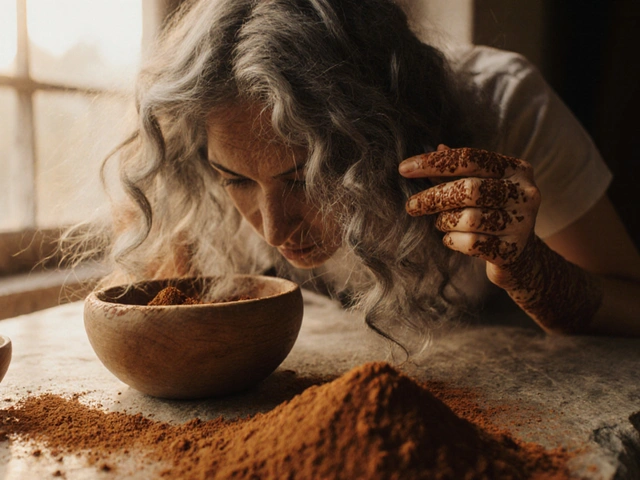
- Plant-based dyes: Henna, indigo, and beetroot can temporarily darken or tint hair. They’re natural but still chemical reactions on the hair shaft.
- Chemical dyes: Oxidative dyes penetrate the hair cortex and permanently alter pigment.
- Supplements: Biotin, vitamin B12, and copper can support healthy melanin production-but only if you’re deficient. They won’t turn gray hair black if your melanocytes are gone.
- Medical treatments: Research is ongoing into stem cell therapies that might reactivate melanocyte stem cells. This is years away from being widely available.
None of these involve meditation.
Where does the myth come from?
This idea likely stems from spiritual traditions that equate inner purity with outer radiance. In some Eastern philosophies, enlightenment is described as a "luminous" state-and people interpret that metaphorically as glowing skin or dark, lustrous hair.
It’s poetic. It’s inspiring. But it’s not biology.
Confusing metaphor with mechanism is common. People once believed that eating carrots would give you night vision. It’s not false-it’s incomplete. Carrots help eye health, but they won’t let you see in the dark. Similarly, meditation helps your hair’s health, but it won’t change its color.
Final reality check
If you’re hoping to reverse gray hair through meditation alone, you’ll be disappointed. But if you’re looking for a natural, sustainable way to support your hair’s health, reduce shedding, and improve its texture-then yes, meditation is one of the best tools you can use.
Don’t waste time visualizing black hair. Instead, sit quietly for 10 minutes a day. Breathe. Let go of tension. Eat well. Sleep enough. Your hair will thank you-not because it changed color, but because it’s finally getting the care it’s been asking for.
Can meditation reverse gray hair?
No, meditation cannot reverse gray hair. Gray hair occurs when melanocyte stem cells in the hair follicle stop producing pigment. Once those cells are gone, they don’t come back through mental practices. However, reducing stress through meditation may slow further graying in early stages by lowering cortisol levels, which can accelerate pigment loss.
Does stress cause gray hair?
Yes, chronic stress can accelerate graying. A 2020 Columbia University study showed that periods of high stress correlated with increased graying in some individuals. When stress was reduced, a small number of hairs regained pigment-but only if the follicles still had active melanocyte stem cells. Stress doesn’t cause gray hair on its own, but it can speed up the natural aging process.
Can visualization change hair color?
No. Visualization affects thoughts and emotions, not biological processes like melanin production. You can’t imagine a new pigment into your hair follicles. Any claims that affirmations or mental imagery change hair color are not supported by biology or scientific evidence.
What’s the fastest way to change hair color naturally?
The fastest natural method is using plant-based dyes like henna or indigo. These coat the hair shaft and can darken or tint hair within hours. They’re temporary, non-permanent, and don’t damage hair like chemical dyes. For lasting color, chemical dyes are still the most effective option.
Can supplements restore hair color?
Supplements like vitamin B12, copper, and biotin can help restore hair color only if you have a deficiency. If your body lacks these nutrients, your melanin production may slow down. Correcting the deficiency can improve pigment-but if your melanocytes are permanently gone, supplements won’t bring back color. They support health, not reversal.



Jim Sonntag
February 23, 2026 AT 17:02Mediation changing hair color? Bro. I meditated for 30 days and my beard went from salt-and-pepper to mostly pepper. Turns out I just stopped dying it and let my natural gray shine. No magic. Just honesty.
Also, henna works. Try it. It's cheaper than therapy.
Deepak Sungra
February 24, 2026 AT 21:47bro i tried visualizing my hair turning black while doing pranayama and now i have a bald spot and a new girlfriend who says i 'vibrate differently' lol
also my mom says i'm cursed now
Samar Omar
February 25, 2026 AT 08:37It's fascinating how Western scientism so aggressively dismisses the subtle energies of Ayurveda and Vedic science. The very notion that melanocyte stem cells are the sole arbiters of hair pigmentation is a reductionist fallacy born of materialist dogma. In classical Sanskrit texts, the prana vayu-specifically the udana vayu-flows upward through the sushumna nadi and directly influences the alochaka pitta, the subtle fire governing luster and hue. When one achieves nirodha samadhi, the body's internal alchemy naturally reorients. The anecdotal reports of monks with restored black hair? Not myth. They're the visible manifestations of a yogic physiology beyond the microscope's grasp.
Science hasn't measured the soul. That doesn't mean it isn't there.
chioma okwara
February 26, 2026 AT 15:33my cousin in lagos she did meditation and her gray hair turned black in 2 months she said she saw god in a dream and he told her to stop eating fried plantain
also she says her nails grew faster now
idk but i believe her she aint lie
John Fox
February 28, 2026 AT 00:01meditation helps with stress
stress makes hair fall out
less stress = less falling out
so you notice more of your original color
not magic
just biology
also stop watching those youtube gurus
Tasha Hernandez
March 1, 2026 AT 10:07Oh my god I can't believe you're still entertaining this pseudoscientific garbage. I had a 12-step program for my hair color obsession last year. I cried into a jar of henna. I screamed at my mirror. I wrote 47 letters to my 17-year-old self. I thought if I forgave my past self for dyeing my hair purple in 2012, maybe my follicles would forgive me too.
They didn't. They just… stayed gray.
And now I'm in therapy. Again.
Anuj Kumar
March 2, 2026 AT 17:54science is a lie
they dont want you to know you can change your hair color with your mind
the government and big pharma are blocking the truth
look at the ancient pyramids
they had black hair
they meditated every day
they knew
they still know
they are watching you right now
Christina Morgan
March 4, 2026 AT 16:59There’s something really beautiful about how much we want to believe our minds can heal us. It’s not about denying science-it’s about honoring the human need for meaning. Meditation won’t turn gray hair black, but it might help you stop seeing gray as a flaw. Maybe that’s the real transformation.
Try it. Not to change your hair. To change how you feel about it.
Kathy Yip
March 5, 2026 AT 08:07i wonder if the fact that we keep asking this question says more about our fear of aging than it does about hair biology
we dont want to accept that some things just… change
we want a mental hack
like life has a cheat code
but maybe the point is there isnt one
and that’s okay
Bridget Kutsche
March 5, 2026 AT 18:31For anyone looking to improve hair health naturally: start with hydration, sleep, and reducing sugar. Meditation helps with all three. I’ve seen clients go from brittle, dull hair to shiny, strong strands in 6 weeks-just by lowering stress and drinking more water.
It’s not magic. It’s just consistent care.
And yes, your hair will thank you. No visualization required.
Jack Gifford
March 6, 2026 AT 02:32I’ve been meditating for 5 years. My hair hasn’t changed color. But I stopped yelling at my cat. That’s a win.
Also, I finally washed my pillowcase. That’s two wins.
Maybe that’s the real spiritual upgrade
Sarah Meadows
March 8, 2026 AT 02:21This article is a classic example of liberal soft science. We used to have standards. We used to know truth. Now we let people believe they can change their biology with breathing. What’s next? Can you manifest a new kidney? Can you visualize a cure for cancer?
Stop giving false hope. Science is not a belief system. It’s a method.
Nathan Pena
March 8, 2026 AT 09:01The Columbia University study you cite is statistically insignificant (n=14), underpowered, and fails to control for confounding variables such as dietary changes, seasonal light exposure, or placebo effects. The claim that hair regained pigment is anecdotal and lacks histological verification. This is not science. It’s media sensationalism dressed in lab coats.
And yet, here we are, treating it like gospel.
How far we’ve fallen.
Mike Marciniak
March 9, 2026 AT 07:03theyre all lying
the real way to change hair color is through subliminal frequencies in binaural beats
if you listen to 432hz while meditating for 40 days straight the melanocytes reboot
the government banned this in 1998 because it made dyes obsolete
you can find the research on the dark web
search: melanin reboot protocol
VIRENDER KAUL
March 9, 2026 AT 15:01It is with profound regret that I must address the lamentable decline in intellectual rigor within contemporary discourse. The conflation of metaphysical metaphor with physiological mechanism constitutes a fundamental epistemological error. One cannot, under any circumstance, posit that the voluntary regulation of respiration may alter the genetic expression of tyrosinase activity within follicular melanocytes. Such a proposition is not merely unsupported-it is ontologically incoherent.
May we return to reason.